2024 Carroll Hart Scholarship Now Open!

The Society of Georgia Archivists is now accepting applications for the 2024 Carroll Hart Scholarship. The application deadline is March 1, 2024.

This year’s Georgia Archives Institute will be held June 3-14, 2024.

For full details, please go to https://soga.wildapricot.org/scholarships/hart

The Society of Georgia Archivists awards a scholarship for attendance at the Georgia Archives Institute held each summer in Atlanta. The purpose of the scholarship is to enhance archival education and membership. The scholarship is named for Carroll Hart, former director of the Georgia Department of Archives and History, founding member of the Society of Georgia Archivists, and founder of the Georgia Archives Institute.

Individuals eligible to compete for the scholarship are:

  • Those engaged in compensated or volunteer archival work at any level in an institution in the state of Georgia.
  • SGA members employed outside the state of Georgia.
  • Graduate students preparing for a career in archives at a college or university in Georgia, or SGA student members studying outside the state of Georgia.
  • Those who identify as members of an underrepresented community or who work with collections that document underrepresented communities or groups.

Preference will be given to applicants who do not have access to institutional support for attending the Georgia Archives Institute.

The scholarship will cover an amount equal to the non credit tuition for the Institute, but not to exceed $550, and a year’s membership in the Society of Georgia Archivists. Please note that individuals must apply separately to the Georgia Archives Institute and pay the application fee to the Georgia Archives Institute. All regular deadlines and requirements for the Georgia Archives Institute apply. After participating in the Georgia Archives Institute, the recipient will submit a brief article on the experience for use in the SGA Newsletter.

How to apply:

Please fill out the online portion of the application for the Carroll Hart Scholarship. Then, to complete your application email your resume or CV and cover letter to scholarships@soga.org. Your application is not complete until these documents have been received.

Complete applications including cover letter and CV or resume must be received by March 1, 2024.

SGA Magazine 2024 Submissions Open!

Calling All SGA Members!

SGA Communications is now accepting submissions of your stories, articles, photos, or other news from this past year for inclusion in the 2024 edition of the SGA annual magazine. The deadline for submissions is Friday, February 16, 2024.

We are especially interested in stories about new and exciting processing projects, maintaining diversity initiatives at your institutions (whether that’s advocating for disabled archivists or seeking out donations from BIPOC communities), and creative events hosted by your institutions that have been pivotal for outreach. If your institution has some other exciting news to share or projects you can’t stop talking about, we welcome those submissions as well!

See past magazine issues for ideas on what we are looking for: https://soga.wildapricot.org/publications/magazine

In your submission please include your name, institution and any relevant photographs with citations to provide visuals in a word or google doc. Send submissions or questions to communications@soga.org.

SGA 2021 Annual Meeting Recordings Available Now

The recordings of the 2021 SGA Annual Meeting are now available to view online! If you were unable to attend the conference live or missed a session you really wanted to attend, we invite you to view the playlist of presentations on SGA’s YouTube.

The presentations are unlisted, so you cannot access them by visiting our page or searching for them on YouTube. They are only viewable through this link, https://www.youtube.com/playlist?list=PLH2n1apWPCoP98qJads742hVdd2Gt0dXm

While you are on the playlist be sure to subscribe to our channel!

Georgia Archives Institute 2022: New Professionals Education Opportunity

GAI is now accepting applications

The online application for the 2022 Georgia Archives Institute is now live! https://www.georgiaarchivesinstitute.org/application-2022

June 6-17, 2022 is the projected date for the Georgia Archives Institute. As of this writing, they plan on having the Institute in person. They will of course monitor the changing health concerns.

The Institute will be held at the Georgia Archives, located in Morrow, GA, just outside Atlanta. Classroom instruction will take place the first week, June 6 through June 10 and also on Monday, June 13. Tuesday, Wednesday and Thursday June 14-16 will be an on-site internship at a local institution, where you can ask all the questions you want and put your classroom instruction to good use. Friday, June 17 will be a wrap-up day, held back at the Georgia Archives.

Be sure to check out the scholarship opportunities available to students. Details can be found here https://www.georgiaarchivesinstitute.org/support.

If you would like a practical course in archives, make a note on your calendar today and stay tuned to their website https://www.georgiaarchivesinstitute.org/, and Facebook page, https://www.facebook.com/georgiaarchivesinstitute.

History of GAI

The Georgia Archives Institute was founded in 1967 by Carroll Hart, Director of the Georgia Department of Archives and History (1964-1982). Lacking the funds to send staff to the National Archives Institute in Washington, D.C., Ms. Hart brought in prominent archivists to teach archival theory and the role of the modern archivist. She saw the need for basic instruction for beginners in the profession. At first the program was intended for the Georgia Archives staff, but it was soon expanded to include attendees from other institutions. The first official session was in August of 1967, with students traveling around the state visiting repositories, courthouses, and other institutions’ housing records.

Today, the Georgia Archives Institute is recognized throughout the archival community as one of the primary vehicles through which beginning archivists and students can learn theoretical and practical knowledge of modern archives.

DEADLINE TO SUBMIT YOUR APPLICATION IS MARCH 15, 2022 https://www.georgiaarchivesinstitute.org/application-2022

New Exhibition: RE-COR-DARE: SAUDA MITCHELL

April 16, 2021 to February 27, 2022

Jepson Center at the Telfair Museum in Savannah, GA

Re-Cor-Dare is a solo art exhibition of Society of Georgia Archivists member and artist Sauda Mitchell (American, b. 1981).

About the exhibition:

“Mitchell’s prints, paintings, and artist books serve as compelling visual responses to her sustained engagement with archival collection materials. In researching personal papers, photographs, artifacts, and curated digital collections, her work explores thematic topics of study relating to the Black experience. Utilizing QR codes, selected works link to digitized collection materials focusing on their ability as teaching tools recalling stories embedded within the African American collective memory.

The hyphenated title, Re-Cor-Dare, calls attention to the definition of the word “record” through its Latin roots―explicitly “Cor” (heart) and “Dare” (to give). Through five distinct but interconnecting series, Mitchell traces the legacies of slavery in the United States from the Middle Passage to present-day social injustices faced by Black Americans. Ultimately, her work exists as a catalyst for discussion, reflection, and a celebration of the human spirit.”

Learn more and see some of Sauda’s works by visiting: https://www.telfair.org/exhibitions/re-cor-dare-sauda-mitchell/

Annual Magazine Now Available

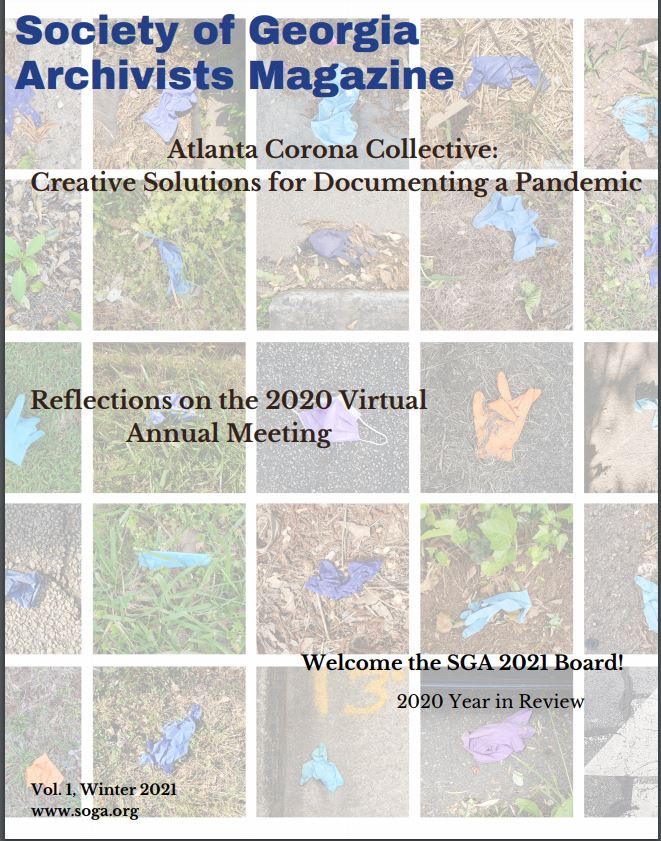
Image of the cover of the 2021 SGA Annual Magazine
Cover of 2021 SGA Annual Magazine

The SGA Communications team is pleased to announce that

the Annual Magazine is now available. 

Check it out here!
The magazine includes reflections on 2020, the virtual annual meeting, documenting the coronavirus, the 2021 president’s address, and more. 


Thank you to those who submitted contributions to the magazine. If you have any questions about the magazine, feel free to contact us. 

Check out past issues of the magazine here.

Call for GHRAC Awards Nominations


Contact
Penny Cliff
Telephone 678.364.3807
Email Penelope.Cliff@usg.edu
Website http://www.georgiaarchives.org/
FOR IMMEDIATE RELEASE
January 28, 2021

Reward Excellent Work in Archives

Call for GHRAC Awards Nominations

Morrow, GA, January 28, 2021– Do you know someone who has done outstanding work using, preserving, or making historical records more accessible?  Think about an historical or genealogical society, library, museum, county or municipal government, researcher, local historian, educator, or student.  The Georgia Historical Records Advisory Council (GHRAC) wants to encourage and reward their exceptional efforts. 

GHRAC established the Outstanding Archives Awards Program in 2003 to recognize outstanding efforts in archives and records work in Georgia. By publicly recognizing excellent achievements, the Board strives to inspire others. Hundreds of organizations and individuals play a significant role in the preservation of our state’s documentary heritage. 

GHRAC has twelve different award categories for individuals and organizations. Award recipients will be honored at the Georgia Archives by the GHRAC Board at a ceremony during Archives Month in October. Nominations may be submitted February 1 through June 1. Nominations must be postmarked on or before June 1, 2021.  

All of the following are eligible for an award. (You may nominate your own organization.)  

  • local governments, courts, school systems, state agencies, and institutions
  • historical records repositories, historical societies, libraries, and museums
  • educators, students, and researchers
  • legislators and government officials
  • individuals and organizations who support archives and records management
  • specialized subject societies in related fields such as oral history, genealogy, folklore, archaeology, business history, etc.

Information about the GHRAC Awards Program is located on the website of the Georgia Archives, www.georgiaarchives.org. On the homepage, type “GHRAC” in the search bar. You can then click on the link to the “GHRAC Awards Program.” Here you will find the links for the Nomination Form and instructions, the Award Categories and Selection Criteria for all 12 awards categories, and a list of all prior award recipients.

A nomination package consists of the one-page nomination form (please provide all requested contact information), a 500-word summary or project description, a copy of the work itself, and any supporting documentation necessary to appropriately portray the complete work (such as in the case of a project which includes an exhibit, a website, or an audiovisual, instructional, service, or performance component). Please note specific requirements in the appropriate selection criteria for nominations.

If submitted electronically, one copy of the nomination package should be emailed to: Linda.Pickering@usg.edu. If submitted as hard copy, seven (7) complete nomination packages should be sent to: GHRAC, c/o Linda Pickering, Georgia Archives 5800 Jonesboro Rd. Morrow, GA 30260 (Copies will not be returned). Nominators should pay particular attention to the following requirements: 1. Georgia students who research and write in an area other than Georgia history or a Georgia subject must use the resources of Georgia records repositories to qualify for these awards. 2. A letter of support from a professor, teacher, adviser, or other appropriate representative of an organization or institution must accompany students who nominate themselves or are nominated by a family member. Award recipients are typically notified in August or September, and the annual GHRAC Awards Reception and Ceremony are held at the Georgia Archives in October.

Don’t miss out on this opportunity to get involved and shine the spotlight on the organizations and individuals all across Georgia who are dedicated to preserving and sharing our history, and improving our record keeping. 

For additional information, please contact GHRAC by phone at 678-364-3806, or email Christopher.Davidson@usg.edu.

SGA 2020 Annual Meeting Recordings Now Available

The recordings from the 2020 Annual Meeting are now available online! If you were unable to attend the conference live, or if you’d like to revisit a favorite session, we invite you to view a playlist of the presentations at https://bit.ly/SGA2020AnnualMeeting. We encourage you to check out Dorothy Berry’s keynote address.

The majority of recordings are set as unlisted, which means you won’t find them by searching YouTube or visiting SGA’s channel. To access the presentations, please save and use the playlist links above.

Digital Library of Georgia (DLG) awards eight Georgia cultural heritage institutions across the state Competitive Digitization service grants

For Immediate Release 
January 6, 2021
CONTACT: Sheila McAlister, mcalists@uga.edu, 706-542-5418
WRITER: Mandy Mastrovita, mastrovi@uga.edu, 706-583-0209  

Digital Library of Georgia (DLG) awards eight Georgia cultural heritage institutions across the state Competitive Digitization service grants.
Eight institutions (and nine projects) are recipients of the eighth set of service grants awarded in a program intended to broaden partner participation in the DLG. The DLG solicited proposals for historic digitization projects in a statewide call, and applicants submitted proposals for projects with a cost of up to $7,500.00. DLG staff will provide free digitization, metadata, and hosting services so that more of Georgia’s diverse history can be found online free. This subgranting program was presented the 2018 Award for Excellence in Archival Program Development by a State Institution by the Georgia Historical Records Advisory Council (GHRAC). Preference in the selection process was given to proposals from institutions that had not yet collaborated with the DLG. The Archives of the Society of Mary, Province of the USA, the 6th Cavalry Museum, the Georgia B. Williams Nursing Home, and the Midway Museum are all new partners for the DLG. The selected collections document all corners of the state and life from the 1700s to the 1996 Olympics. There’s something for everyone: family researchers will find plantation, funeral home, county government, and nursing home records; art enthusiasts will learn of the Atlanta Symphony Orchestra’s growth from its founding in 1945 to the mid-1980s; those interested in protest and politics can study community resistance to the 1996 Olympics, view the effects of segregation policies in urban planning, and encounter the changing face of Atlanta and Savannah’s public spaces in the 1950s. The materials document the state’s African American, Roman Catholic, and military communities.
The recipients and their projects include: 
Georgia State University Special Collections and Archives (Music and Broadcasting Collections)
Digitization of 24 scrapbooks from the Atlanta Symphony Orchestra (ASO) Collection dating from 1945 to 1985 that include newspaper clippings of concert previews, reviews, and highlights of guest performers, composers, and conductors, as well as photographs, advertising materials, and organizational records such as memos and correspondence. The bulk of the ASO scrapbooks are from the 1950s-1960s and document the arrival of Music Director Robert Shaw in the late 1960s and the effects of the Civil Rights movement on the orchestra.
Georgia State University Special Collections and Archives (Women’s Collections)
Digitization of audiovisual items from the Carol Brown Papers, 1993-2012 (bulk 1993-1994) focusing on pro- and anti- LGBTQ+ activities in traditionally conservative Cobb County and the campaign to move 1996 Olympic events out of the County. Further, in a time of daily protest, the collection illustrates the power of creative, peaceful protest.
City of Savannah Municipal Archives
Digitization of the selections from Park and Tree Commission minutes from 1896 to 1920 that reflect the intersections of urban planning and civil rights, trends in landscape design, development of Savannah’s cemeteries (both African American and white, since Savannah had segregated cemeteries), and details such as the use of convict labor in city infrastructure projects. These records offer insider perspectives into the decision-making process related to these Jim Crow-era policies that are not often found in government records.
Greater Clarks Hill Regional Library System
Digitization of the Rees Funeral Home Funeral Records and the Lincoln County Courthouse Records. The Rees Funeral Home Funeral Records document funeral arrangements and obituaries for Lincoln County residents from 1940 until 1960. The Courthouse records consist of Lincoln County legal records dating back to the 1700s.
Archives of the Society of Mary, Province of the United States
Digitization of films and slides dating from 1938 to 1979 and drawn from Marist College educator Reverend Michael Kerwick’s films and from the papers of Marist educator Rev. Vincent Brennan. The materials document the Marist School community in Atlanta and, more broadly Roman Catholics in Georgia. 
6th Cavalry Museum
Digitization of a collection of holiday menus created for the 6th Cavalry troops at Fort Oglethorpe from 1925 to 1940. The holiday dinner menus offer a glimpse of food and culinary traditions and of military life through troop rosters and highlights of each year’s troop activities.
Georgia B. Williams Nursing Home
Digitization of the Georgia B. Williams Nursing Home Archives documents the first maternity shelter where “only” African American women were allowed, by local Mitchell County doctors, to receive midwife delivery for their newborns. Materials in the collection include registers of the mothers and babies born between 1949 and 1971.
Midway Museum
Digitization of the Julia King Collection, composed of original land grants/deeds, plantation documents, indentures, estate documents, photos, and letters connected with the Roswell King family’s Liberty County plantation and the county itself from the late 1700s through the middle of the 20th century. The collection will be of particular interest to those doing family research on the enslaved in Liberty County.
Georgia Historical Society
Description of architectural drawings from the Savannah-based, woman landscape architect Clermont Lee. Lee is best known for her work designing gardens and parks for historical landmarks throughout Georgia. The drawings are from 1940 through the mid-1980s and include projects in and around Savannah, as well as several throughout Georgia and the larger Southeast. More information about our partner institutions is available below:

About the Georgia State University Special Collections and Archives (Music and Broadcasting Collections)
The Georgia State University Archives Music and Radio Broadcasting Collections began as the Johnny Mercer Collection and grew to include related materials that include: other musicians’ and artists’ papers, early country, bluegrass and Southern gospel music, Atlanta Symphony Orchestra archives, and records of WSB Radio and other Georgia stations. The collection contains more than 20,000 pieces of published sheet music, Tune-Dex cards, and arrangements by American songwriters, as well as 50,000 recordings from a variety of genres. For more information, visit the Music and Radio Broadcasting Collections research guides at research.library.gsu.edu/musicradio 

About the Georgia State University Special Collections and Archives (Women’s Collections)
The Women’s Collections chronicle women’s activism and advocacy in Georgia and the Southeast. Within this curatorial area are several notable collections: the Donna Novak Coles Georgia Women’s Movement Archives, the Lucy Hargrett Draper Collections on Women’s Rights, Advocacy and the Law, and the Archives for Research on Women. For more information, read the Women’s Collections research guides at research.library.gsu.edu/womenscollections 

About the City of Savannah Municipal Archives
The City of Savannah Municipal Archives collects, manages, preserves, and makes accessible records documenting the City of Savannah’s history; administers the records management program and the City Records Center to increase the efficiency of City agencies; and shares the City’s history with City employees, citizens and visitors through outreach activities. The Municipal Archives services reference requests from researchers and the general public which relate to archival and historical City records under its administration in the City Records Center and shares the City’s history through a variety of public outreach activities, including tours of City Hall, permanent and rotating exhibits, and special programs. Visit www.savannahga.gov/475/Municipal-Archives 

About the Greater Clarks Hill Regional Library System 
The Greater Clarks Hill Regional Library System aims to provide quality library services and materials to children and adults in the community in order to meet their informational, recreational, and educational reading needs. Visit gchrl.org/ 

About the Archives of the Society of Mary, Province of the United States
The mission of the archives is to collect, preserve, and make available manuscripts, records, photographs, audiovisual materials, artifacts, books, and other items that document the ministries, houses, and personnel of the Society of Mary in the United States. Although Marists first arrived in Louisiana in 1863, items in the collection date from the early 1800s through 2020. The provincial archives for the U.S. Province have been housed in the rectory at Marist School in Atlanta, Georgia since 2000, when the former Washington and San Francisco provinces consolidated into the Atlanta province. The archival collection of the former Boston province was moved from Framingham to Atlanta in 2014. 

About the 6th Cavalry Museum
The 6th Cavalry Museum preserves the rich military history of the Fighting Sixth Cavalry, stationed at The Post at Fort Oglethorpe from 1919-1942. The story of the 6th Cavalry began in 1861 as a U.S. Cavalry Regiment. Located on the Post’s original parade ground/polo field, the area is listed on the National Register of Historic Places, surrounded by officer’s homes and other Post buildings. The museum opened in 1981 through the volunteer efforts of the local WWII 6th Cavalrymen, their families, and interested residents. Visited by presidents, military heroes, and celebrities, the museum houses artifacts, uniforms, weapons, accoutrements, photos, and vehicles. Visit 6thcavalrymuseum.org/ 

About the Georgia B. Williams Nursing Home
Listed on the National Register of Historic Places in 2011, the Georgia B. Williams Nursing Home in Camilla, Georgia was the only facility where African-American women could deliver babies in Mitchell County, for many years prior to the Civil Rights Movement. It was owned by Beatrice (“Miss Bea”) Borders (1892–1971), a midwife who delivered over 6,000 babies at the home between 1941-1971.

About the Midway Museum
Since its founding, the Midway Museum has been supported by the descendants of the Midway Church members who have provided 18th- and 19th-century family heirlooms, documents, books, genealogical lineages, heirloom furnishings, paintings, and artifacts. Many Midway Church descendants still live in Liberty County and coastal Georgia, serve on the Board of Governors, and visit during the Midway Church’s annual Homecoming. Visit themidwaymuseum.org/ 

About the Georgia Historical Society
Georgia Historical Society (GHS) is the premier independent statewide institution responsible for collecting, examining, and teaching Georgia history.  GHS houses the oldest and most distinguished collection of materials related exclusively to Georgia history in the nation. Visit georgiahistory.com/ 

About the Digital Library of Georgia 
Based at the University of Georgia Libraries, the Digital Library of Georgia is a GALILEO initiative that collaborates with Georgia’s libraries, archives, museums, and other institutions of education and culture to provide access to key information resources on Georgia history, culture, and life. This primary mission is accomplished through the ongoing development, maintenance, and preservation of digital collections and online digital library resources. DLG also serves as Georgia’s service hub for the Digital Public Library of America and as the home of the Georgia Newspaper Project, the state’s historic newspaper microfilming project. Visit the DLG at dlg.usg.edu.

SGA Hosts First-Ever Virtual Annual Meeting

The Society of Georgia Archivists held its 51st Annual Meeting November 11-13, 2020–its first-ever all-virtual conference–with the theme “Building Partnerships and Dismantling Barriers.” Our keynote speaker was Dorothy Berry, Digital Collections Program Manager at Harvard’s Houghton Library, whose talk was titled, “My Soul Looks Back in Wonder: Remembering Black History in the Archives.”

In spite of all the changes and challenges presented by this year, the conference was the best-attended of any meeting in the Society’s history, boasting 206 registrants, 200 attendees, 58 presenters, 26 presentations, and seven vendors. SGA was proud to be able to offer free registration to members and presenters, and $35 registration to non-members. 

Our two pre-conference workshops were similarly well-attended, hitting capacity in both virtual events. On November 5, 2020, Magda Pecsenye, creator of the Tilmor Process, presented “Manage Your Team to Greater Efficiency and Engagement with the Tilmor Process,” and on November 6, Shaundra Walker, Interim Director of the University Library, Georgia College, presented the workshop, “Critical Race Theory and the Archive.”

All meetings were held via Zoom, and the conference planning committees opted to have two day-long tracks to minimize the number of links attendees would need to manage. We chose not to employ a managed content platform, choosing instead to provide the links to registered attendees via the annual meeting program and daily email blasts. This decision allowed overhead costs for running the meeting to be kept to a minimum.

The planning committees additionally kept a Slack workspace with multiple channels open for the duration of the conference. This space was used not only to troubleshoot technology issues, but also to provide an informal chat environment for attendees to connect with one another and with vendors. The SGA Executive Board also maintained a channel to address questions about our duties, share opportunities for committee work, and to encourage members to run for office.

Our vendors, too, had an important role to play in the conference. Depending upon their chosen level of sponsorship, vendors were able to give presentations during conference breaks, and were thanked by facilitators at the start of each session. Some sponsors contributed either virtual or physical giveaways for our attendee swag bags and raffle prizes. 

In all, we are pleased with the conference’s success and happy to answer questions from other state and regional organizations planning a similar shift to an online conference. Feel free to contact us anytime. 

Written and contributed by Angela Stanley, 2020 SGA President.