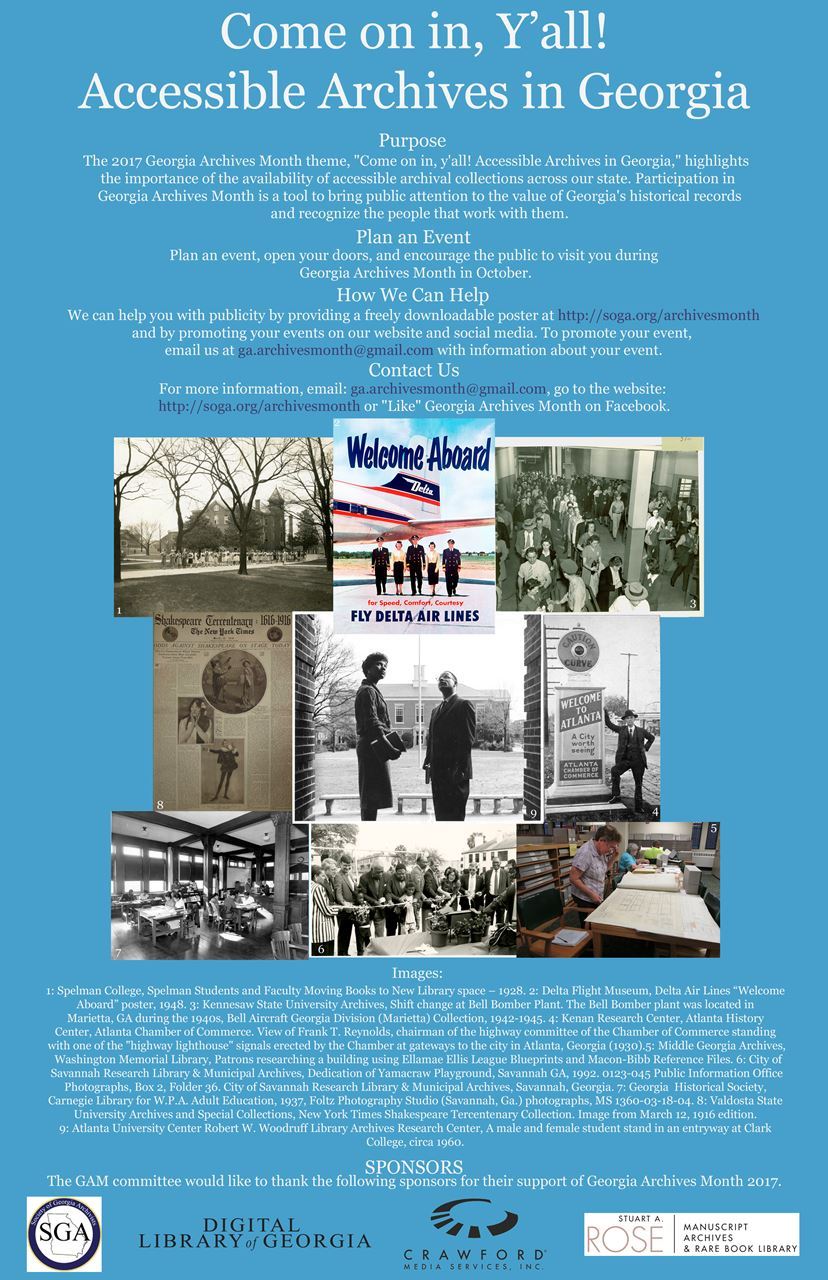
Georgia Archives Month!

HAPPY GEORGIA ARCHIVES MONTH!

Georgia Archives Month (GAM) is an exciting and important month for archivists and archival institutions in Georgia. GAM was officially recognized in 2000 thanks to a proclamation made by Governor Roy Barnes. GAM is sponsored by the Society of Georgia Archivists. For the first six years, GAM events took place during the course of one week in October, but in 2007, these events began to extend throughout the course of the entire month.

This year’s theme for GAM is “Come on in Y’all: Accessible Archives in Georgia.” There are so many great ways that Georgia archival institutions are making their collections accessible to the public, and the SGA Outreach Team wants to highlight these awesome ideas all month. Whether it’s processing a new collection, advocating for your repository, or developing new outreach tools – we want to hear about it! Email outreach@soga.org to share your GAM announcements and experiences.

To learn more about the history of the Society of Georgia Archivists and Georgia Archives Month, visit http://www.georgiaencyclopedia.org/articles/education/society-georgia-archivists.

Let’s Advocate!

As archivists, we know that advocating for our profession is a crucial part of our work. The Academy of Certified Archivists includes advocacy within one of the seven main domains of the archival profession. ACA explains that archivists must “develop an understanding of, and support for, the archival program among resource allocators, key constituents, potential donors, allied professionals, and other internal and external stakeholders to the archives’ parent organization” (ACA Exam Handbook 21). Advocating for our profession can take many forms – public programming, meetings with local and state politicians, donor relations, fundraising, activism, etc. For the Society of Georgia Archivists, activism kicked into high gear roughly five years ago when the future of the Georgia Archives was in danger. Now that this threat has passed, it is time to start thinking about advocacy in a long-term sense. While issue-based advocacy is important, it is also necessary to engage in a steady rhythm of advocacy so that our community understands the value of what we do.
The SGA Outreach Team has made it a point to focus on advocacy for fall 2017. We are excited to see the inroads we can make in Georgia to help inform our community of the archival profession. Here are some ideas we are considering…
        Developing an advocacy “workflow” for current and future members of the SGA Outreach Team
        Setting up meetings with our local and state politicians to discuss our purpose as archivists
        Inviting stakeholders to SGA events
        Targeting SGA social media to address issues specifically related to advocacy   
SGA Members with Governor Nathan Deal at the 2016 Georgia Archives Month Proclamation Signing

What other ideas do you have for advocacy? Let us know!!

"Tackling the ACA Exam" (written by Tiffany Atwater)

“The best way to finish an unpleasant task is to get started” ~Anonymous
No one likes taking tests! We study, cry, study some more, eat ice cream and then study again,—or maybe this was just my experience in graduate school. Nonetheless, through my matriculation of grad school, there was one nagging thought in my mind. “What if I graduate but can’t pass the Certification Exam?” Scary right, well, not exactly.  Unlike some professions, not passing the exam does not signify a nail in the coffin of my career, — it is nonetheless, a testament to my understanding of the profession and my ability to maintain standards of excellence in historical preservation and access to primary resources. The certification exam, was developed by the Academy of Certified Archivists, founded in 1989 at the annual meeting of the Society of American Archivists.”<!–[if supportFields]> CITATION Aca17 \l 1033 <![endif]–> (Academy of Certified Archivists, 2017)<!–[if supportFields]><![endif]–>The ACA exam was established in conjunction with the Society of American Archivists and the Interim Board for Certification (IBC) in order to promote understanding of archival goals, ethics and standards. The examination is conducted annually in conjunction with the Society of American Archivist’s Annual Meeting. Applicants are able to take the test either at SAA’s annual meeting or request a host city where 3 or more applicants wish to take the test.
I applied for the test last year, and I must say as scared as I was about taking the exam, I was more inspired by the sight of all the other test takers in the room with me. Seeing former classmates and current colleagues take the test was exciting. One of the ways I studied for the exam was by reaching out to colleagues who had taken the test. One of the most surprising pieces of advice I received was to “relax.” The exam is challenging; it’s supposed to be. If everyone could pass, what would make the profession so special? Being an archivist is more than putting old stuff in boxes. It’s someone who preserves, manages, and provides access to the past. We are the gatekeepers to history, but more importantly we are a legitimate profession that requires training and higher education. We are not just a title to be used for the person who keeps all the “old stuff.” The certification exam is the Academy’s effort to help validate what we, as working archivists, already know — our profession takes skill.
I eventually studied hard and passed the exam, and I encourage anyone who has been procrastinating, scared, or even unaware to visit the Academy of Certified Archivists website and learn more about certification. The Academy even provides an exam handbook that serves as a guide for anyone desiring to become certified. It includes an explanation of the Academy’s structure, principles guiding the exam’s creation, sample questions, study guide and bibliography. While it is too late to register for the upcoming 2017 exam, remember that applications for the 2018 exam usually open in February. For those who are taking the exam this year, I will see you July 26th as I am one of the proctors for the Atlanta site.

A wise person once said, “The best way to finish an unpleasant task is to get started.” Who that person is, I don’t know perhaps an archivist will find this quote in an archive somewhere, and when they do, hopefully the archivist will have a CA after their title. 
Written by Tiffany Atwater

We’re Back!

Greetings all!

The  SGA Outreach team is excited to announce that we are officially reviving our blog! Thank you for your patience during our hiatus.

Our first blog post is going to focus on membership. Membership is crucial to the success of SGA because without dedicated members who volunteer their time and resources to serve on the SGA board, attend SGA events and meetings, mentor one another, or even just promote the archival endeavor in Georgia, our Society could not exist. You do not have to be a full-time archivist to be a member of SGA. Anyone can join. We welcome a diverse group of members who are committed to working together for the betterment of archives in our state. In fact, the SGA Diversity Initiative Task Force just completed the first statement on diversity and inclusion for SGA. Check it out here.

The SGA Membership Committee specifically works toward meeting the needs of current SGA members as well as recruiting new members. The Outreach Committee works closely with the Membership Committee to plan events and campaigns to encourage membership participation. Take a look at the latest update from Sarah Tanner, the 2017 SGA Membership Chair:

Dear SGA Members,
The Membership Committee, in 2016, began working closely with the Outreach Committee to combine our efforts to help support current SGA membership and expand our reach in recruiting new members. We have had three joint meetings to plan and promote SGA activities for the 2017 year. The Membership Committee has several ongoing tasks, including welcoming new members, planning tours of Georgia repositories, connecting members through social and networking events, and partnering with the Mentoring Committee to identify ways to connect new members with the Mentoring Program. This year the Membership Committee planned a joint Lego+Local Brew networking event with the Special Libraries Association and other professional organizations at the Museum of Modern Design, sent informational emails to historical societies, faculty, and students in archival programs, and is working on several upcoming events for the summer. The Membership Committee, along with the Outreach Committee is working with the Georgia Archives Institute to plan a repository tour of the Auburn Avenue Research Center in June and an SGA member happy hour at the Brick Store Pub this summer. Stay tuned for more information about these upcoming events.
In addition to these events, committee members have been working on a variety of tasks from SGA’s Strategic Timetable, including drafting and submitting a Diversity Statement for the SGA Board, and reaching out to members in other areas of Georgia to plan casual meet-ups in cities beyond Atlanta. If you or anyone you know is interested in working with the Membership Committee to plan an event in your area, please contact me!

The Membership Committee is designed to work on programs to recruit and retain members, as well as develop membership benefits. If you have any feedback, comments, or concerns, I would love to hear from you.  

Thanks for the update, Sarah! And to all of our SGA members, thank you for making us the incredible Society that we are!


Call for session/poster proposals for SFA/SGA Joint Meeting this October


The 2016 Society of Georgia Archivists/Society of Florida Archivists Programming Committee proudly announces the theme for the 2016 Joint Conference:
Defining Archives: Ingenuity, Innovation, and New Perspectives
The Committee invites you to submit your workshop, session, and poster ideas to help make this year’s conference a great success!  Defining Archives calls for archives professionals to explore the inventive and enterprising use of archival concepts, functions, and methods through time and across disciplines. Conference program proposals are sought that highlight innovative research, applied projects, and collective insights that improve our understanding of the following key topics:
  • The archival environment, including issues, successes, and key operational differences experienced while working in corporate archives, special collections, academic repositories, and public libraries; 
  • The roles of archivists as educators, reference sources, spokespeople, liaisons, and gatekeepers; changing jobs and titles and how these varied responsibilities are handled in daily work;
  • The vision of archives and next steps for the profession, including novel approaches to archival education, recruiting new generations of archivists, and creatively engaging with researchers and the community;
  • The creative practice of archives and the ways in which archivists create innovative responses to challenges such as rapidly changing formats, digital preservation, web archiving, unconventional projects, building exhibits and the management of exponentially larger volumes of data.

The theme announcement and session proposal guidelines can be found online at http://bit.ly/1WOOZjW.  The deadline for session/poster proposals is July 15, 2016. 

We are looking forward to our Joint Conference in Savannah, Georgia, October 13-14, 2016!  For more information about the joint meeting, please see http://www.soga.org/annualmeeting

Call for papers: 2016 issue of Provenance

Provenance: The Journal of the Society of Georgia Archivists, a peer reviewed academic publication, seeks articles on archival theory and practice for the 2016 issue. Please note that the content of the journal is not limited to the state of Georgia, and articles of regional or national significance are welcome. First-time authors are especially encouraged to submit articles for consideration. As evidenced by the forthcoming audiovisual issue, composed of video, audio, and traditional article formats, Provenance is also interested in innovative and unique methods for presenting scholarly content.
Articles on archival topics outside of theory and practice which meet publication standards will also be considered. Typical papers should be a Word document, 10-20 pages, double spaced, and formatted according to the 16th edition of the Chicago Manual of Style. Please review information for contributors: http://digitalcommons.kennesaw.edu/provenance/policies.html. Articles are to be submitted utilizing Provenance’s new online system: http://digitalcommons.kennesaw.edu/provenance/.
For additional information contact Editor Heather Oswald at: provenance@soga.org. Deadline for contributions is July 31, 2016.

Call for papers: Provenance Audiovisual Special Issue

Provenance recognizes the evolving needs within the profession and is working to address those changes when possible. For example, we published a special issue on advocacy in September 2013 (http://digitalcommons.kennesaw.edu/provenance/).
Provenance would like to create a special issue dedicated to audiovisual archives and archivists. Despite two journals dedicated to archival audiovisual topics (http://www.iasa-web.org/iasa-journal andhttp://www.arsc-audio.org/journal.html), Provenance will take a different approach. What we propose is to create an issue where there may be written content, but the bulk of it would be original audio and visual “articles.” Submissions should be specifically about processes, procedures, projects, collecting, digitizing, providing access, or other aspects about managing audiovisual collections.
Following the model of innovative projects such as “More Podcast, Less Process,” we are seeking alternative means of disseminating research and ideas. Audio and video are powerful tools for demonstrating practices, projects, policies, or other content. We invite you to be creative in how you utilize these formats.
Proposals should be up to 750 words and include an abstract of the project, why an audiovisual/written format is ideal to present the topic, and the type/format of the proposed submission. As this is a new format for Provenance, proposals will be reviewed by the Editors for creativity, clarity of thesis/topic, and appropriateness to audiovisual formats. Editors will provide guidance and additional specifications to accepted authors to ensure a high-quality end product.
Suggested submissions include but are not limited to:
  • virtual tour or review of tool or procedure
  • podcasts
  • video tutorial
  • written article combined with audio or video or procedures
Submissions should not be:
  • recordings of conference presentations
  • entire oral histories or digitally reformatted materials
This will be published as an online-only issue, openly available to everyone, in fall of 2016. We recognize that because this process is new, we want to provide enough time for submission, review, and edits to produce an issue. The suggested timeline is as follows:
September 2015 – send out call for proposalsNovember 15, 2015 – proposals dueDecember 2015 – editors select proposals and notify all submittersMay 15, 2016 – deadline for final submissionsMay-June 2016 – editorial review of submissionsJuly 2016 – minor revisions of submissions (if needed)August 2016 – final review by authors/editorsSeptember 2016 – published online (http://digitalcommons.kennesaw.edu/provenance/)
Written submissions can be submitted via the online system:http://digitalcommons.kennesaw.edu/provenance/. Audiovisual submissions can be emailed or shared through Google Drive/Dropbox to the Editor at provenance@soga.org.
Formats:
  • Audio files should be in .mp3 format; video files in .mp4 format.
  • Contributors can also provide embed codes from YouTube, Kaltura, or others if his/her institution utilizes other platforms.
  • All submissions should include a transcript of the audio or video to increase discoverability.
  • No minimum nor maximum word length for traditional article submissions.
  • Consult with Editors for other options.
Written submissions should adhere to established guidelines: http://digitalcommons.kennesaw.edu/provenance/policies.html. Audiovisual submissions will not be peer-reviewed in the traditional sense. Because there are no standard guidelines for reviewing audiovisual content, the focus will be on quality of viewing and content. This process will be flexible and is subject to change.
Provenance looks forward to working with you!
Thank you,
Cheryl Oestreicher, Editor, Provenance, Journal of the Society of Georgia Archivistsprovenance@soga.org
Heather Oswald, Associate Editor, Provenance, Journal of the Society of Georgia Archivistshoswald@kennesaw.edu
Jennifer Welch, Reviews Editor, Provenance, Journal of the Society of Georgia Archivistsjwelch30@uthsc.edu   

2014 SGA Annual Meeting Breakout Sessions Recap: Let’s talk about digital preservation!

In an effort to engage the rich discussions that were had as part of the “Everyday Digital Archives” breakout sessions at the 2014 SGA Annual Meeting, here is the final post, highlighting topics that arose during the fourth breakout session, in which the always exciting topic of digital preservation was discussed!  Hopefully this post (and the previous three!) will be thought provoking to the SGA membership and will help to contribute to the ongoing conversation about the many issues that come part and parcel with managing digital archives.
Breakout Session 4: Preservation of Digital Records
This breakout session explored the current state of digital preservation among SGA members, discussed first steps toward establishing digital preservation policy and practice, identified significant challenges among member institutions and developed suggestions for ways in which SGA could better support digital preservation for archival professionals in Georgia.  Here are some highlights of topics that were discussed:
Challenges
  • Insufficient resources (both financial and staffing)
  • Problems with sustainability because it can be difficult to get necessary commitments for ongoing support of digital preservation
  • Slow implementation at some organizations because of the “tyranny of perfection”; administration and/or upper management waiting for perfect solutions instead of simply getting started
  • Difficulty of selling the idea that something is better than nothing (again moving out from under the tyranny of perfection)
  • Steep learning curve (for example some institutions/professionals paralyzed when faced with engaging with digital preservation elements like the OAIS reference model)
Observations
  • Archives professionals need to be able to plan and implement digital preservation solutions that are realistic and feasible without getting burdened with the need for perfect solutions
  • Even with institutional support, we need to develop feasible, realistic digital preservation plans that can be implemented with success
  • There is a need for advocacy, both externally and internally, as part of digital preservation planning (demand from users, support from within institutions)
  • Getting technical systems and policy in place is hard but “cultural policy” is hard too
  • When developing digital preservation policy, remember to refer to existing relevant documentation like preservation policy for physical collection or collection management policy; don’t reinvent the wheel.
  • Exploring the role (and practice) of appraisal with digital preservation and policy development
What can SGA do to help? (Ideas)
  • Program in digital preservation (create committee to organize this, set objectives, decide issues and report from across state/region)
  • Create a list or index of policy statements on digital preservation and/or digital collection management
    • Must have variety, peer-to-peer institutions
      • Small institutions, large institutions
      • From institutions with “established” digital programs and “emerging” digital programs
    • Maybe closed to SGA members only, not open on web, to encourage sharing
    • Not just digital preservation policies need to be shared, but also the goals for creating a policy, and how much of that goal institutions are accomplishing
  • Create model similar to SAA best practices and processes by which institutions come to digital preservation strategies
  • Dedicate issue of Provenance to digital preservation
  • Digital preservation “Match.com” for mentoring
  • List of SGA Annual Meeting attendees for networking

Hopefully the ideas/issues/thoughts shared here have been useful.  Feel free to leave your thoughts in a comment!