Outreach Collaborative Idea: Providing “Real World” Client Experience
This collaboration began in the fall of 2010 and continued through the spring of 2011, with plans to continue due to its success as an experiential learning experience and promotional tool for Special Collections.
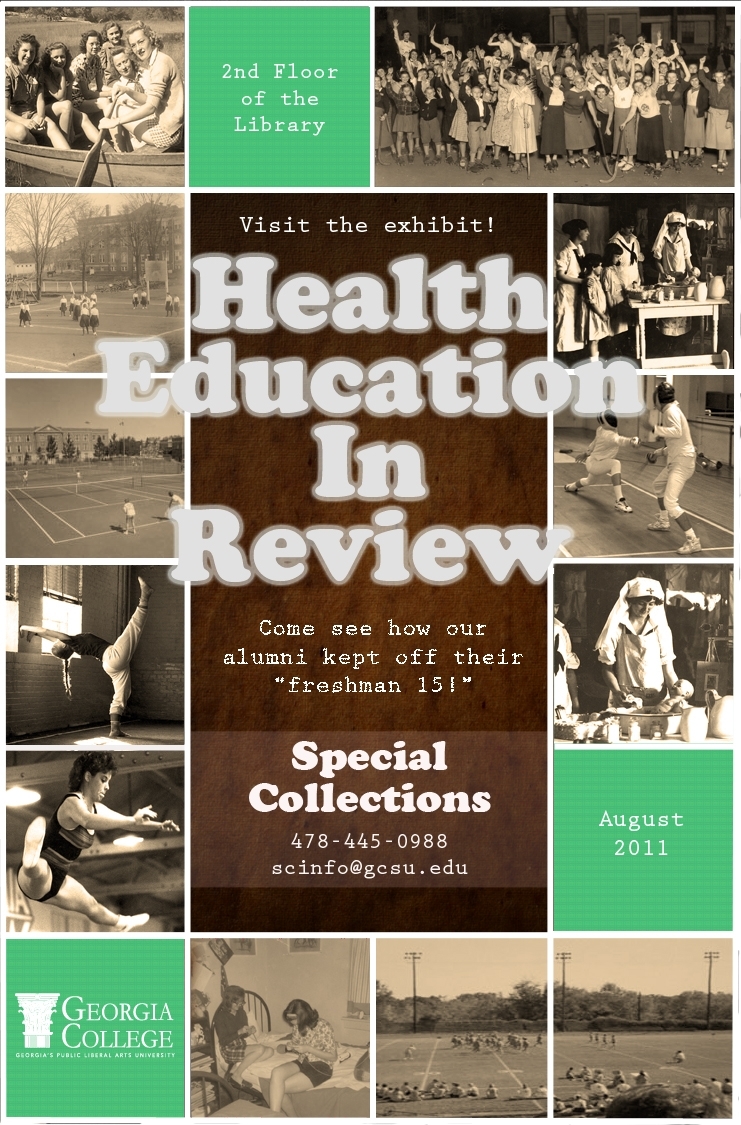
Special Collections and the class teamed up to create a “real-world” client-based experience. In this collaboration, students learned about the importance of primary source research and the function of archives. Special Collections then tasked the students to design two posters (using the department’s photographs) advertising a future exhibit, “Health Education in Review” and the department’s oral history initiative, “The Legacy Project.” A week after projects were assigned, students presented their proofs to Special Collections staff members who critiqued posters for clarity of information and visual impact. The students then spent two weeks editing their work. Special Collections’ personnel made a final visit to select the two winning poster designs which were showcased on campus and throughout the local area.
Please contact Special Collections for further information about the Legacy Project, exhibit, or collaboration by calling (478) 445-0988 or by emailing scinfo@gcsu.edu.
*Contributed by Katherine Pope, Georgia College & State University.
SGA Members Set to Take Over ACA!
There are three (3) SGA members running for national positions with the Academy of Certified Archivists. If you are a member of ACA, please review their candidate statements and consider them as you vote.
Running for Vice President/President Elect:
Kaye Minchew
Troup County Historical Society and Archives
Question: “What is the primary benefit of ACA membership and why?”
Running for Secretary:
Renna Tuten
Richard B. Russell Library for Political Research and Studies, UGA
Question: “What is the primary benefit of ACA membership and why?”
Spotlight on "Provenance"
p.p1 {margin: 0.0px 0.0px 0.0px 0.0px; font: 12.0px Times} p.p2 {margin: 0.0px 0.0px 0.0px 0.0px; font: 12.0px Times; min-height: 14.0px} p.p3 {margin: 0.0px 0.0px 0.0px 0.0px; font: 12.0px Times; color: #0033cc; min-height: 14.0px} span.s1 {color: #0033cc} ul.ul1 {list-style-type: disc}
- archival education
- electronic records
- automation
- imaging
- appraisal of university records
- moving archives
- management of audiovisual, photograph, oral history, and map materials
- military archives
- documentary editing
- research use of archives
- case studies in appraising congressional papers
- ethics
- descriptive standards
*Contributed by Laura Starratt, Atlanta History Center.
Workshop: Disaster Recovery
News from just next door in South Carolina…
No ever thinks of the disasters that could strike an archives or library.
Sure there are hurricanes, floods, and fires. But, what about the less obvious disasters like busted pipes, sewage leaks, or a leaky HVAC unit?
Do you know what to do when a sudden disaster befalls a collection at an archives or library?
In conjunction with the Palmetto, Archives, Libraries, and Museum Council on Preservation (PALMCOP), the Archival Students Guild is proud to host a disaster workshop. Preservation officer, Heather South will present “Disaster Recovery and Response: An Exercise in Disaster and Planning. Participants will gain hands-on experience in salvaging documents and other materials in the event of a disaster.
Where: South Carolina Department of Archives and History (8301 Parklane Road, Columbia, SC 29223)
Date: Saturday, March 26, 2011
What time: 10 a.m. (please arrive between 9:30 and 9:45)
Please complete the registration form by March 20, 2011. The registration form should be emailed to soarchiv@mailbox.sc.edu. Space is limited to the first 30 people. Lunch will be provided courtesy of ASG.
Come rain or shine, this event will take place and wear comfortable shoes.
Georgia College Publishes Cartoons of Famed Alumnae Flannery O’Connor
Gordon is the former editor of the Flannery O’Connor Review and former director of the O’Connor Studies Program at Georgia College.
The book includes a foreword by university President Dorothy Leland.
“It is a distinct honor for Georgia College to be the permanent home of the O’Connor Collection, including the cartoons originally published by Georgia State College for Women and now featured for the first time in this book,” Dr. Leland wrote in the foreword. “We are pleased that these cartoons can now reach a broader audience and further enrich Flannery O’Connor scholarship.”
The book cover features a graphic signature that O’Connor used, combining her initials, M, O’C and F (Mary Flannery O’Connor) to create a caricature of a bird. While some of the cartoons were digitally enhanced for the publication, care was taken not to alter the art.
The cartoons originally appeared in The Colonnade student newspaper, The Spectrum yearbook, The Corinthian literary magazine and the Alumnae Journal. Also included are cartoons that O’Connor drew earlier for The Peabody Palladium, the student newspaper of Peabody High School in Milledgeville.
The original cartoons are housed in Georgia College Special Collections, as part of its permanent O’Connor Collection, along with thousands of pages of typescripts and manuscripts, photographs, tape recordings, films, letters, memorabilia and her personal library of more than 700 books and journals.
2011 Georgia Archives Institute
It’s time to apply for the 2011 Georgia Archives Institute!
June 6 – 17, 2011
P.O. Box 279
Morrow, GA 30260-0279
Email: GeorgiaArchivesInstitute@yahoo.com
SAA: Philip M. Hamer and Elizabeth Hamer Kegan Award
Please excuse cross-postings!
Society of American Archivists – Philip M. Hamer and Elizabeth Hamer Kegan Award
The Philip M. Hamer and Elizabeth Hamer Kegan Award Subcommittee of the Society of American Archivists seeks nominations for the 2011 award.
This award recognizes an archivist, editor, group of individuals, or institution that has increased public awareness of a specific body of documents through compilation, transcription, exhibition, or public presentation of archives or manuscript materials for educational, instructional, or other public purpose. Archives may include photographs, films, and visual archives. Publication may be in hard copy, microfilm, digital, or other circulating medium.
Recent winners include:
2010 The Giza Archives Project at the Museum of Fine Arts, Boston
2009 Ward M. Canaday Center for Special Collections of the University of Toledo’s “From Institution to Independence”
2008 Canadian Broadcasting Corporation and the CBC Digital Archives (Les Archives de Radio-Canada)
2007 National Library of Medicine’s “Profiles in Science”
Eligibility:
Individual archivists and editors, groups of individuals, organizations.
Application Deadline:
All nominations shall be submitted to the Awards Committee by February 28.
For more information on SAA awards and the nominations process, please go to http://www.archivists.org/recognition/index.asp
44th Annual Georgia Archives Institute
Designed for beginning archivists, manuscript curators, and librarians, the 44th Georgia Archives Institute will offer general instruction in basic concepts and practices of archival administration and management of traditional and modern documentary materials. The Institute will be held at the Georgia Archives in Morrow, Georgia, 15 miles south of Atlanta.
Dr. Timothy L. Ericson, former Director of Archival Studies, University of Wisconsin-Milwaukee School of Information Studies, will be the instructor during the first week. Topics will include acquisition, appraisal, arrangement, description, reference, as well as legal and administrative issues. The second week of instruction will begin with training on preservation by Christine Wiseman, Preservation Manager at the Georgia Archives. To link archival theory with real world application, students will also participate in individualized, three-day internships at local archival repositories.
Tuition is $500. Enrollment is limited and the deadline for receipt of application, resume, and $75 application fee (refunded if not admitted to Institute) is March 1, 2011. Tuition does not cover transportation, housing, or meals.
Tuition scholarships are available from the Society of Georgia Archivists, www.soga.org and The Friends of Georgia Archives and History, www.FOGAH.org. Scholarships have earlier deadlines.
For an application to the Institute or information, please visit the Georgia Archives Institute web site at www.georgiaarchivesinstitute.org or contact:
News From Next Door: South Carolina Edition
The Waring Historical Library and MUSC University Archives announce the opening of a new web exhibit:
“Civil Practice to Civil War: The Medical College of the State of South Carolina, 1861-1865”
http://waring.library.musc.edu/exhibits/civilwar/
The Medical College of the State of South Carolina (MCSSC), as it was known from 1832 until 1952, suspended classes after the March 1861 graduation, just three months after South Carolina seceded from the Union and a month before shots upon Fort Sumter marked the official commencement of hostilities between North and South. Almost immediately, many of the College’s faculty, students, and alumni joined the Confederate military and the College was left dormant for five long years. Even while the College was on hiatus, its students, alumni, and faculty were getting an entirely new education in the field hospitals and on the battlefields. The exhibit tells the stories of but a few of the hundreds of MCSSC’s alumni, faculty and students who took their medical bags to war.
For more information about the web exhibit, please contact Brooke Fox, University Archivist at foxeb@musc.edu.
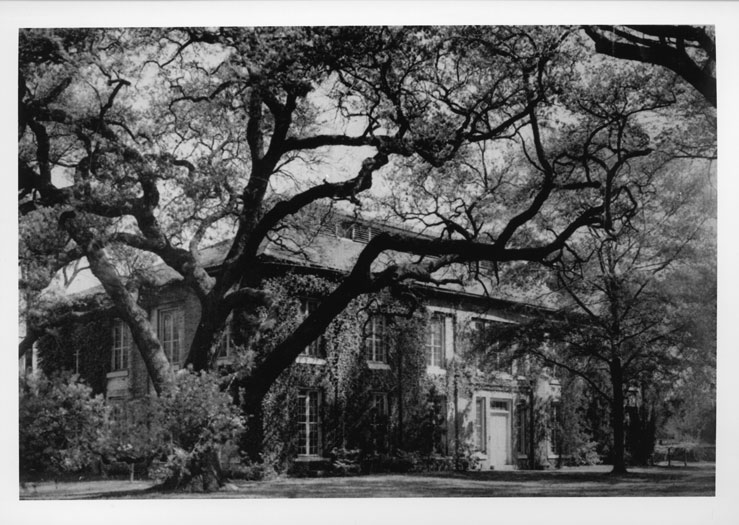
*Colcock Hall, n.d., Waring Historical Library, MUSC, Charleston, SC