Digital Library of Georgia (DLG) awards six Competitive Digitization service grants to Georgia cultural heritage institutions across the state

WRITER: Mandy Mastrovita, mastrovi@uga.edu, 706-583-0209
CONTACT: Sheila McAlister, mcalists@uga.edu, 706-542-5418
ATHENS, Ga. — Digital Library of Georgia (DLG) awards six Competitive Digitization service grants to Georgia cultural heritage institutions across the state.
Six institutions are recipients of the fifth set of service grants awarded in a program intended to broaden partner participation in the DLG. The DLG solicited proposals for historic digitization projects in a statewide call, and applicants submitted proposals for projects with a cost of up to $7,500.00 The projects will be administered by DLG staff who will perform digitization and descriptive services on textual (not including newspapers), graphic, and audio-visual materials. This subgranting program was presented the 2018 Award for Excellence in Archival Program Development by a State Institution by the Georgia Historical Records Advisory Council (GHRAC).
The recipients and their projects include:
  • Columbia Theological Seminary (Decatur, Ga.)
Digitization of the Joseph R. Wilson papers, late 1800s (containing the sermons of Joseph Ruggles Wilson, the pastor of First Presbyterian Church in Augusta from 1858-1870); John Newton Waddel papers, 1821-1881 (materials belonging to John Newton Waddel (1812-1885) and his father Moses Waddel (1770-1840), both Georgia Presbyterian ministers and educators); and the Presbyterian Church in the U.S. Presbytery of Hopewell minutes, 1797-1866 (minutes from Georgia’s first Presbytery belonging to the Presbyterian Church from the period following the Revolutionary War through the Civil War).
  • Dougherty County Public Library (Albany, Ga.)
Digitization of city directories for Albany, Georgia, dating from 1922-1949.
  • Jimmy Carter Presidential Library and Museum (Atlanta, Ga.)
Description of archival documents that highlight notable events and accomplishments during Jimmy Carter’s presidential administration from 1977-1981 that include the Camp David Accords (1978), the hostage crisis in Iran (1979-1981), the Panama Canal Treaties (1977-1978), the president’s daily diary (1977-1981), presidential directives (1977-1981), presidential review memoranda (1977-1979), and legislation towards the progression of the Equal Rights Amendment (ERA).
  • National Civil War Naval Museum (Columbus, Ga.)
Digitization of a ledger from the James H. Warner Collection containing correspondence from Warner, commander and superintendent of the Confederate States Naval Iron Works (sometimes referred to as the Columbus Iron Works) which operated from 1862-1865. The ledger also includes entries as late as 1866 as Warner worked with the United States Navy in turning over naval equipment to the United States government.
  • University of Georgia Map and Government Information Library (Athens, Ga.)
Digitization of Sanborn fire insurance maps produced in 1923 for 21 Georgia towns and cities in 17 counties.
  • Valdosta State University Archives and Special Collections (Valdosta, Ga.)
Digitization of Georgia deeds and plats representing southeastern and south Georgia counties(including Camden, Glynn, Wayne, Brantley, Ware, and Worth counties) dating from the 1700s-1899.

Preference in the selection process was given to proposals from institutions that had not yet collaborated with the DLG. Dougherty County Public Library and the National Civil War Naval Museum are both new partners for the DLG. Sheila McAlister, director of the Digital Library of Georgia, notes: “Since the start of DLG’s subgranting program in 2016, we’ve funded 26 projects and added 10 new partners. Documenting the entire state, the collections illuminate the lives of Georgia’s African-American, LGBTQ, and Asian-American communities, as well as the state’s educational, political, cultural and industrial past.”
About Columbia Theological Seminary
Columbia Theological Seminary exists to educate and nurture faithful, imaginative, and effective leaders for the sake of the church and the world. It is an educational institution of the Presbyterian Church (U.S.A.) and a community of theological inquiry, leadership development, and formation for ministry in the service of the church of Jesus Christ. Visit https://www.ctsnet.edu/
About Dougherty County Public Library
The Dougherty County Public Library’s mission is to select, assemble and administer organized collections of educational and recreational library materials; to serve the community as a center of reliable information and a place where inquiring minds may encounter original, unorthodox, or critical ideas in our society; to provide opportunities and encouragement for individuals to continue their educations; to supplement and help formal education programs; to seek, continually, to identify community needs; to support civic groups, cultural activities, or cooperate with other agencies as they work for community good; to maintain and disseminate public information encouraging to individuals to better use the libraries as well as to contribute to the field of professional librarianship; to enhance interest and research in local history; and to provide opportunity for substantive recreational and constructive use of leisure time through the use of literature, music, films, and other forms. Visit http://docolib.org/
About the Jimmy Carter Presidential Library and Museum
The Jimmy Carter Presidential Library and Museum in Atlanta, Georgia houses U.S. President Jimmy Carter’s papers and other material relating to the Carter Administration and the Carter family’s life. Visit https://www.jimmycarterlibrary.gov/
About the National Civil War Naval Museum
The National Civil War Naval Museum houses the largest surviving Confederate warship, the CSS Jackson, as well as the wreckage of the CSS Chattahoochee, and the largest collection of Civil War Naval-related flags on display in the country. Their timeline exhibit shows naval events and features many of the museum’s most rare artifacts, such as the uniform coat of Captain Catesby Jones and Admiral Farragut’s two-star hat insignia. The museum hosts a range of events throughout the year with an emphasis on museum theatre and historic character interpretation. Additionally, there are living history events, tours, cannon firings, weapons demonstrations, local history projects, and more. Visit https://www.portcolumbus.org/
About the University of Georgia Map and Government Information Library
The University of Georgia Map and Government Information Library (MAGIL)’s mission is to provide bibliographic, physical, and intellectual access to cartographic and government information in all formats. The UGA Libraries serves as Georgia’s regional depository for documents published by the Federal government as well as the official depository for documents published by the State of Georgia. Its collections include select international and United Nations documents. Cartographic resources include maps, aerial photography and remote sensed imagery, atlases, digital spatial data, and reference materials, with a particular emphasis on the State of Georgia. Visit https://www.libs.uga.edu/magil
About Valdosta State University Archives and Special Collections
The VSU Archives and Special Collections supports the University’s commitment to scholarly and creative work, enhances instructional effectiveness, encourages faculty scholarly pursuits, and supports research in selective areas of institutional strength focused on regional need by collecting, preserving, and providing access to records of enduring historical value documenting the history and development of VSU and the surrounding South Georgia region and in support of VSU curriculum. Visit https://www.valdosta.edu/academics/library/depts/archives-and-special-collections/
About the Digital Library of Georgia
Based at the University of Georgia Libraries, the Digital Library of Georgia https://dlg.usg.edu/ is a GALILEO initiative that collaborates with Georgia’s libraries, archives, museums and other institutions of education and culture to provide access to key information resources on Georgia history, culture, and life. This primary mission is accomplished through the ongoing development, maintenance, and preservation of digital collections and online digital library resources.  DLG also serves as Georgia’s service hub for the Digital Public Library of America and as the home of the Georgia Newspaper Project, the state’s historic newspaper microfilming project.
New oral history collection documents disability experience in Georgia

June 20, 2019
CONTACT: Deborah Hakes, dhakes@georgialibraries.org
ATLANTA…Georgia Public Library Service is pleased to announce the release of Our Stories, Our Lives, an oral history collection of stories to preserve and document a more complete history of the disability experience, specifically that of people with print disabilities who are living in Georgia.
“Interviewees shared their experiences with us, whether it was a life story or a period of time that was significant to them,” said Georgia Libraries for Accessible Statewide Services (GLASS) Outreach Librarian Stephanie Irvin, who managed the project. “We heard such a variety of beautiful stories that exemplify both how unique our patrons are and the rich lives they have; this collection challenges the general perception of what it means to live with disability.”
 
Through GLASS, the Georgia Public Library Service provides library services for individuals who are blind and to those whose physical abilities require the use of books and magazines in audio format or in braille. GLASS talking book and large-print library has more than 450,000 annual checkouts, and users who are physically unable to visit a library can obtain materials freely by mail.
Audio interviews and transcripts maintain the authentic voices of people who have a print disability, including visual impairment, physical impairment, blindness or a reading disability.
“GLASS was pleased to curate Our Stories, Our Lives to show disability is not a one-size-fits-all experience as a part of our ongoing efforts to promote accessible library services in Georgia,” said Assistant State Librarian and GLASS Director Pat Herndon.
The digital repository of Our Stories, Our Lives is hosted by the Richard B. Russell Library for Political Research and Studies, who partnered with GLASS to archive the project.

####
About Georgia Public Library Service
Georgia Public Library Service (GPLS) empowers libraries to improve the lives of all Georgians by encouraging reading, literacy, and education through the continuing support and improvement of our public libraries. GPLS is a unit of the Board of Regents of the University System of Georgia. www.georgialibraries.org #georgialibraries
About the Georgia Libraries for Accessible Statewide Services
Georgia Libraries for Accessible Statewide Services (GLASS) supports accessible library services in Georgia by promoting the use of assistive technology and by providing accessible reading materials to those who, due to a disability, are unable to read standard print.
This partnership is paid for in part by a grant to the Georgia Public Library Service from the Institute of Museum and Library Services under the Library Services and Technology Act.

Edward Weldon Scholarship Applications Open June 1

The 2019 Society of Georgia Archivists Scholarship committee is proud to announce the opening of applications for the Edward Weldon Scholarship.  Applications will be accepted June 1st– July 5th.2019.
The Society of Georgia Archivists’ Edward Weldon Scholarship provides funding for registration for an SGA member to attend the Society of American Archivists (SAA) annual meeting. The Edward Weldon Scholarship was established in 2000 to recognize Ed’s leadership in furthering the preservation and access of Georgia’s historical records.
The scholarship covers only the amount of the early-bird-Advance registration fee. The award recipient is responsible for covering any costs associated with travel and accommodations. Please note that the scholarship winner is responsible for submitting their SAA meeting registration by the early-bird/advance registration deadline. After the SAA meeting, the recipient will submit their SAA registration receipt to the SGA Treasurer for reimbursement, as well as a brief article on the experience for use in the SGA Magazine.
Individuals eligible to compete for the scholarship are:
·         must be members of SGA (as of February 1 of the current year)
·         residents of the State of Georgia
·         Preference will be given to applicants who do not have access to institutional support for attending the Society of American Archivists annual meeting
To apply for the Edward Weldon Scholarship, please fill out the application, with all required supplemental materials, prior to Friday July 5th. Applicants are strongly encouraged to complete the digital application to avoid problems with postal delivery. Please note that the application must be RECEIVED (not postmarked) by July 5, 2019, to qualify.
For more information regarding this scholarship, please contact: scholarships@soga.org

Fire at Highlander Center

By Laurel Bowen, University Archivist, Georgia State University


Atlanta is well known for civil rights activism, as evidenced by the numerous archival repositories, cultural resources, and historical sites that bear witness to that history. They include:

        National Center for Civil and Human Rights;
        Civil Rights Digital Library;
        Morehouse College’s Martin Luther King, Jr., Collection;
        Archives and research centers at the Atlanta University Center, Atlanta History Center, and Atlanta-Fulton Public Library;
        Civil rights collections and materials at Georgia Tech, University of Georgia, Georgia State University, and Emory University;
        Living Atlanta Oral History Collection at the American Folklife Center (Library of Congress);
        Martin Luther King, Jr. National Historical Park (formerly MLK National Historic Site);
        Atlanta’s “Off the Wall” public art collection (murals) documenting civil rights and social justice movements.
Colleagues who attended the SGA conference last October may remember an afternoon session on “Split Collections: Outreach Across Multiple Institutions.” The session explored ways to identify and cooperatively expand access to African-American history collections split among different institutions. One of the four presenters was Susan Williams, coordinator of the Highlander Library/Resource Center and a member of the Education team.
We often focus on public demonstrations and other expressions of activism. We should also consider the origins of advocacy—how advocates are motivated, what strategies they choose, and by what means a movement grows. The Highlander Center (https://www.highlandercenter.org/about-us/), created in 1932 as the Highlander Folk School, has long served as an important Tennessee-based social justice incubator, offering a forum for discussion as well as workshops and training sessions for those concerned with social and economic issues. In the 1930s and 1940s this work focused on the unemployed and evolved into a training center for union organizers in eleven southern states. In the 1950s and 1960s the Highlander provided a non-segregated space for interaction, discussion, and strategy development for many Atlanta civil rights leaders including Rosa Parks, Ralph David Abernathy, and Martin Luther King, Jr. Following several government investigations of the Folk School’s work during the McCarthy and early civil rights eras, the state of Tennessee revoked its charter in 1961 and seized its land and buildings. The school reopened the next day as the Highlander Research and Education Center and relocated to Knoxville, where it remained for a decade until it moved in 1972 to its current location near New Market.
At our last SGA conference, this past history as a social justice center and the resulting government actions were cited as a rationale for moving many of the Highlander’s oldest and most historic records to an off-site archival repository. Five months after our conference—on March 29—the Highlander was the target of suspected arson. According to news reports, investigators were focusing on a symbol spray painted on the pavement near the charred building. The symbol, resembling a hashtag or tic-tac-toe grid but with three horizontal and vertical lines, is known to be used by white supremacists.
The Atlanta civil rights connection is explored in an article in the Atlanta Journal-Constitution. Later reports in the Knoxville News Sentinel (4/5/19) indicate the symbol may have existed prior to the fire, but Tennessee Congressman Steve Cohen (D-Memphis) has called for a federal investigation. While the oldest group of the Highlander’s archival records (dating from about 1917 to 2005) are at the Wisconsin Historical Society, the Highlander said “decades of historic documents” had been destroyed in the fire. An update on May 14 from the Highlander says the cause of the fire is still undetermined, but all of the staff are safe and messages of encouragement and support continue to pour in from around the world.

Georgia Archives Month Spotlight Grant applications due May 31

Applications are being accepted for the Georgia Archives Month’s Spotlight Grant, and the deadline is May 31st!
The Spotlight on Archives Grant is intended to help archives, museums, or heritage institutions in Georgia promote public awareness of their archives and manuscript collections during Georgia Archives Month in October. This year, there will be one award of $500. 

Award monies are intended to be used by the selected institution to fund an event held during Georgia Archives Month in October 2019. The money can be used for the event’s expenses. The 2019 theme is “Looking Forward, Looking Back: 50 Years of Preserving History”.
You can get your application and specific details HERE.
Apply by May 31st for consideration!
While you’re on the site, check out events hosted by past winners!  Good luck!

Atlanta Housing Archives Finding Aids Now Available Online

The Atlanta Housing (AH) Archives is pleased to announce it has begun publishing preliminary finding aids, available online at https://www.atlantahousing.org/about-us/archives/ . The finding aids consist of accessioned records maintained by the AH Archives of both processed and unprocessed records. 
About the Atlanta Housing (AH) Archives 
The mission of the Archives is to preserve and provide permanent and historical materials that will assist in the operations of AH; to promote knowledge, research and understanding of the origins, functions, programs, and goals of AH; and to collect archival materials that tell the AH story.  

The AH Archives consists of a variety of records, artifacts, moving images, and more than 14,000 photographs dating from the early 1930s document AH’s unique history. AH’s collections strengths include records concerning the history of the first federally funded public housing developments in the United States (Techwood Homes for whites and University Homes for African-Americans), public housing for war workers during WWII, AH’s communities, urban renewal, and AH’s involvement with important public figures who helped shape the story of public housing in Atlanta.

Could you use $500 for archival supplies?

Georgia Archives Month graciously received a gift certificate from Hollinger Metal Edge! The certificate is for $250 and the Georgia Archives Month committee has matched it, for a total grant of $500. We hope to award the grant to institutions that may not necessarily have a trained archivist or an official archival program.
Best of all, it is easy to enter! Simply navigate to our Google forms sheet, making sure to fill in all the fields. This form requires logging in with a Google account. The deadline to apply is Sunday May 5 at 5pm. The drawing will take place on Monday May 6.  Co-Chair Amber and committee member Laurel will draw the lucky winner and we plan to film the drawing and post it on our Facebook page!
Your only requirement, should you win the grant, is to write to us at gaarchivesmonth@soga.org, to let us know how the money was used, share a picture and allow us to share it on Facebook, Twitter, and Instagram!

Feel free to share this opportunity with those who could use it!

The (im)Perfect Storm: a Catastrophic Flood that Didn’t End in Catastrophe

Registration is open for the Annual HERA Atlanta Education Program

Wednesday, May 8, 2019
2-4 PM
Michael C. Carlos Museum, Emory University

The Carlos Museum suffered a catastrophic flood in one of its artwork storage areas in June
2018, forcing a major evacuation of the collection and a subsequent mold remediation and
renovation project that was completed while the museum maintained its operations and busy
exhibitions and programming schedule. A panel of curators, conservators, registrars, and
preparators at the Carlos will share their experiences and lessons learned in an informal “Ask Me
Anything” style discussion.
This program is free. Please RSVP by Wednesday May 1 to Todd Lamkin at
tlamkin@emory.edu. Please use the subject line “HERA 2019”.
The program will be held in Ackerman Hall on the third floor of the Michael C. Carlos Museum.
Directions and parking:

Reward Excellent Work in Archives: Call for GHRAC Award Nominations

Do you know someone who has done outstanding work using, preserving, or making historical records more accessible? Think about the historical or genealogical society, library, museum, county or municipal government, researcher, local historian, educator or student. The Georgia Historical Records Advisory Council (GHRAC) wants to encourage, and reward their efforts. 
The Georgia Historical Records Advisory Council (GHRAC) established the Outstanding Archives Awards Program in 2003 to recognize outstanding efforts in archives and records work in Georgia. By publicly recognizing excellent achievements, the Board strives to inspire others. Hundreds of organizations and individuals play a significant role in the preservation of our state’s documentary heritage. 
  
GHRAC has twelve different award categories for individuals and organizations. Award recipients will be honored at the Georgia Archives by the GHRAC Board at a ceremony during Archives Month in October. Nominations may be submitted February 1 through June 1. Nominations must be postmarked on or before June 1, 2019.  
All of the following are eligible for an award. (You may nominate your own organization.)  

  • local governments, courts, school systems, state agencies, and institutions
  • historical records repositories, historical societies, libraries, and museums
  • educators, students, and researchers
  • legislators and government officials
  • individuals and organizations who support archives and records management
  • specialized subject societies in related fields such as oral history, genealogy, folklore, archaeology, business history, etc.


Information about the GHRAC Awards Program is located on the website of the Georgia Archives. Here you will find the links for the Nomination Form and instructions, the Award Categories and Selection Criteria for all 12 awards categories, and a list of all prior award recipients.
A nomination package consists of the one-page nomination form (please provide all requested contact information), a 500-word summary or project description, a copy of the work itself, and any supporting documentation necessary to appropriately portray the complete work (in the case of a project which includes an exhibit, a website, or an audiovisual, instructional, service, or performance component).
If submitted electronically, one copy of the nomination package should be emailed to:christopher.davidson@usg.edu. If submitted as hard copy, seven (7) complete nomination packages should be sent to: GHRAC, Georgia Archives 5800 Jonesboro Rd. Morrow, GA 30260 (Copies will not be returned.) Nominators should pay particular attention to the following requirements:

1. Georgia students who research and write in an area other than Georgia history or a Georgia subject must use the resources of Georgia records repositories to qualify for these awards.

2. Student nominations which are self-nominated, or nominated by a family member, must be accompanied by a letter of support from a professor, teacher, adviser, or other appropriate representative of an organization or institution.

Award recipients are typically notified in August or September, and the annual GHRAC Awards Reception and Ceremony are typically held at the Georgia Archives in October.
Don’t miss out on this opportunity to get involved and shine the spotlight on the organizations and individuals all across Georgia who are dedicated to preserving and sharing our history. 
For additional information, please contact GHRAC by phone at 678-364-3806, or email christopher.davidson@usg.edu.

Prayer Bead Exhibit: Diocese of Savannah

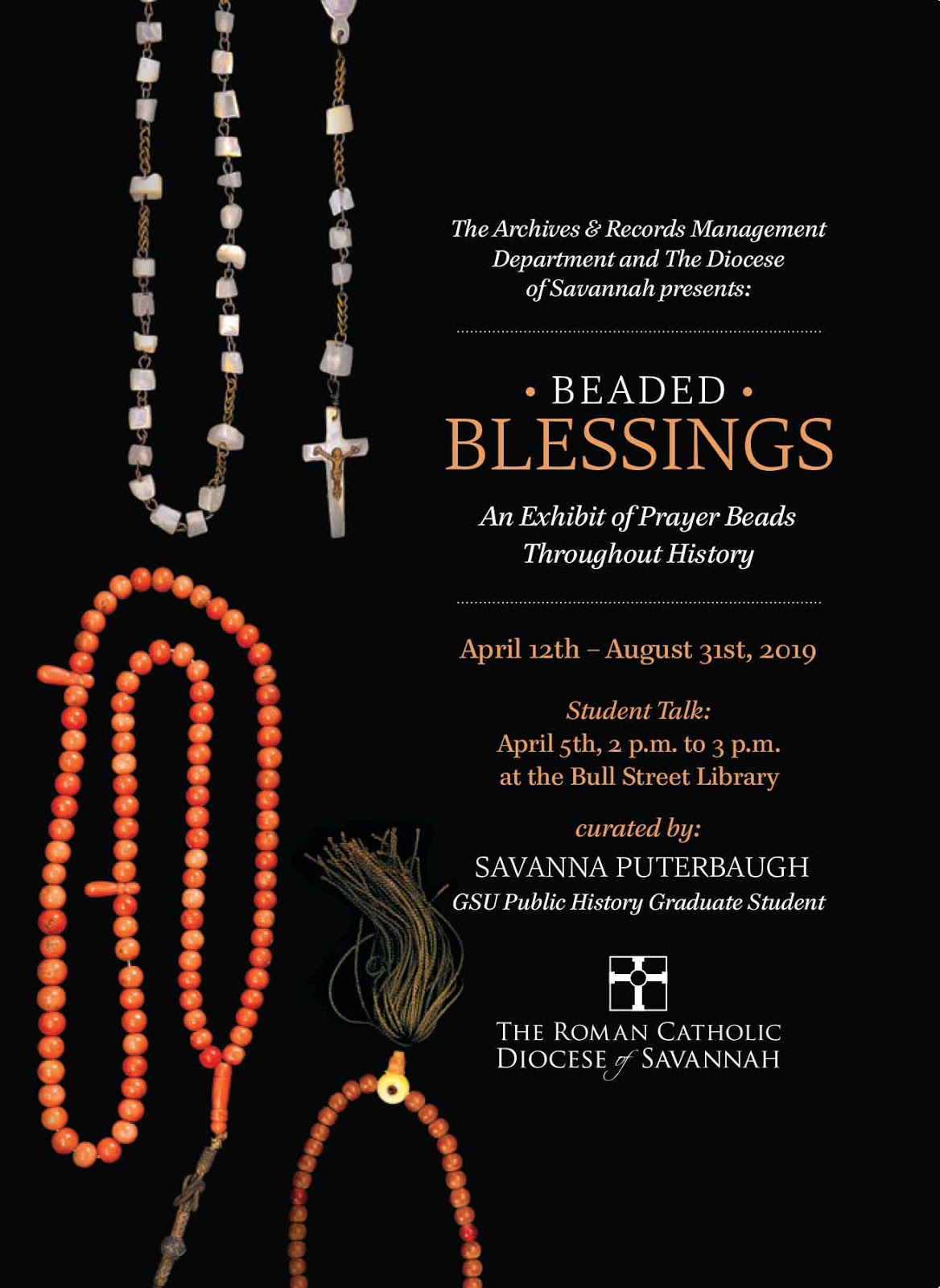
The Diocese of Savannah Archives & Records Management Office is excited to announce our upcoming exhibit Beaded Blessings: Prayer Beads Throughout History.

A preview of the exhibit will be held on Friday April 5th with a presentation by Georgia Southern University Public History Student and exhibit curator Savanna Puterbaugh. The talk will begin at 2 pm at the Bull Street Library (2002 Bull Street, Savannah), Live Oak Public Libraries.

Beaded Blessings: Prayer Beads Throughout History will open to the public on Friday April 12th at the Archives & Records Management Office of the Catholic Diocese of Savannah (2170 East Victory Drive). Please let the front desk know you are here for the exhibit and someone will show you up to the 3rd floor.

The exhibit will be open on Mondays and Friday during our public hours of 9 am to 12 noon between Friday April 12th and Friday August 30th.  Exhibit closure will coincide with building closures of Monday May 27th and Thursday July 4th.

We look forward to seeing you there! Continue to follow us on our website (diosav.org/archives), Facebook (DioSav Archives & Records Office) and on Twitter (@DioSavArchives) for announcements, news, events, #KnowDioSavHistory and #RoaminCatholicArchivist.