SGA Board Approves Salary Transparency Statement

Statement from the SGA Board of Directors

Atlanta, Ga.– On April 20, 2020, the Society of Georgia Archivists’ Board of Directors voted to endorse the Society of American Archivists’ Ad-Hoc Salary Transparency Working Group’s open letter to the SAA Council in favor of a salary transparency policy.  As of June 1, 2020, the Society of Georgia Archivists will no longer post professional opportunities (part-time/temporary jobs, full-time/permanent jobs, or internships) that do not include salary information through any of its organizational communication channels. We will also not accept postings for unpaid internships. 
SGA is taking this step for several reasons: 

  • Multiple surveys of the broader GLAM (Galleries, Libraries, Archives, and Museums) field specifically have affirmed that lack of transparency regarding salaries and earnings expectations is a significant concern for professionals at all stages of their careers. 
  • Several other professional organizations such as AMIA, Northwest Archivists, and Society of Southwest Archivists have changed their policies on job postings to dissuade employers from posting jobs without salary information or unpaid internships.  
  • Recently a group of archivists have included recommendations for active steps to promote salary transparency and advocate for fair wages and hiring practices in our field. In this respect, we are also acting alongside other professional organizations including the Society of American Archivists, American Library Association, and regional archives associations. 

This will mean some open positions available in our field will not be posted on the SGA website or through our other organizational communication channels. 
We believe this step is justified. By keeping salary information secret, employers obscure structural inequalities and enable them to persist. Without salary information, it becomes harder to make the case that one is experiencing pay discrimination. Job postings with undisclosed salary information are a drain on everyone’s resources, wasting both the employer’s and the interviewee’s valuable time and money, even as candidates may not be able to work for the salary offered.
As with salary transparency, a wealth of recent research and reports from the field emphasize the ways in which reliance on unpaid labor in the form of internships further perpetuates systemic inequities and economic injustice, and devalues the skilled labor  performed in archival institutions and collections. 
In restricting employment postings to paid positions only, the Society of Georgia Archivists stands with archival workers to increase the visibility and accessibility of paid professional experiences for students and work for professionals at all career stages.

Related Resources

  • SAA Update: Advocating for archivist pay, view here
  • Business Archives Section (BAS) Salary Requirement Survey, view here
  • Endorsement of a living wage for all library employees and a minimum salary for professional librarians, view here
  • Things that must be talked about, view here.
  • Salary information now required in job postings.
  • Northwest Archivists Policy for Accepting Job Postings, view here.
  • Wages for intern work: De-Normalizing unpaid positions in libraries and archives, view here.

This policy is based on AMIA’s “Board Position Statement on Salary Transparency.”  View the SGA Board’s full statement here.
SGA Endorses the SAA Council’s Statement on Black Lives and Archives

On June 4, 2020, the SGA Board voted unanimously to endorse the SAA Council’s Statement on Black Lives and Archives, and voiced its unequivocal opposition to the harassment, violence, and neglect of Black and brown communities

It is now up to each of us to continue the much harder work of putting this statement into action. As archivists, we reckon with history deeply and often, and we acknowledge the existence and particular U.S. legacy of structural racism, white supremacy, militarism, gatekeeping, and institutional power. We also recognize moments of grace, collective uprising, community solidarity, cultural exchange, and the power of transformative justice. 

As we are each called to consider our spheres of influence and how within them we might effect change, I would also ask you to consider ways SGA might change, too. Your Board is in the process of identifying short-term internal and external actions we can take, as well as finalizing a proactive strategic plan for the longer term. We will be coming to you with questions that will help inform our priorities for future action, and we hope you’ll consider providing your thoughtful feedback.

As always, your Board members are here for your concerns, questions, and ideas. Please don’t hesitate to reach out to any of us at any point if there is something you’d like to discuss.

Wishing each of you and your families safety, health, and peace.

Georgia Archives Virtual Lunch and Learn: Discovering Your Georgia Roots Using the Virtual Vault

Discovering Your Georgia Roots
Using the Virtual Vault
June 2020 Virtual Lunch and Learn
On Friday, June 12, 2020, noon-1:00 p.m., the Georgia Archives’ first virtual Lunch and Learn program will be available to the public. Discovering Your Georgia Roots Using the Virtual Vaultwill be presented by Reference Archivist Tamika Strong. 
The goals for the presentation are to discuss and explore resources that can be utilized to trace family roots in Georgia and share the methodology and research tips to locate records in the Virtual Vault.
The Georgia Archives’ Virtual Vault is a portal to some of Georgia’s most important historical documents, from 1733 to the present. The Vault provides virtual access to historic Georgia manuscripts, photographs, maps, and government records housed at the Archives.
The live event is hosted through Microsoft Teams. Use browsers Chrome, Firefox, Microsoft Edge, or Internet Explorer 11. If you plan on using an iPhone or tablet, you may have to download the Microsoft Teams app. Click on Join Live Event to join the Lunch and Learn.
If you have any questions, please email Georgia Archives Education Specialist Penny Cliff at penelope.cliff@usg.edu.
Lunch and Learn Programs are free and open to the public and are sponsored by Friends of Georgia Archives and History (FOGAH). 

Church Record Book from Harris County Covering the Years 1828-1915 now Available Online in the Digital Library of Georgia

WRITER: Mandy Mastrovita, mastrovi@uga.edu, 706-583-0209
CONTACT: Sheila McAlister, mcalists@uga.edu, 706-542-5418
ATHENS, Ga. — Church record book from Harris County covering the years 1828-1915 now available online in the Digital Library of Georgia.
 
 
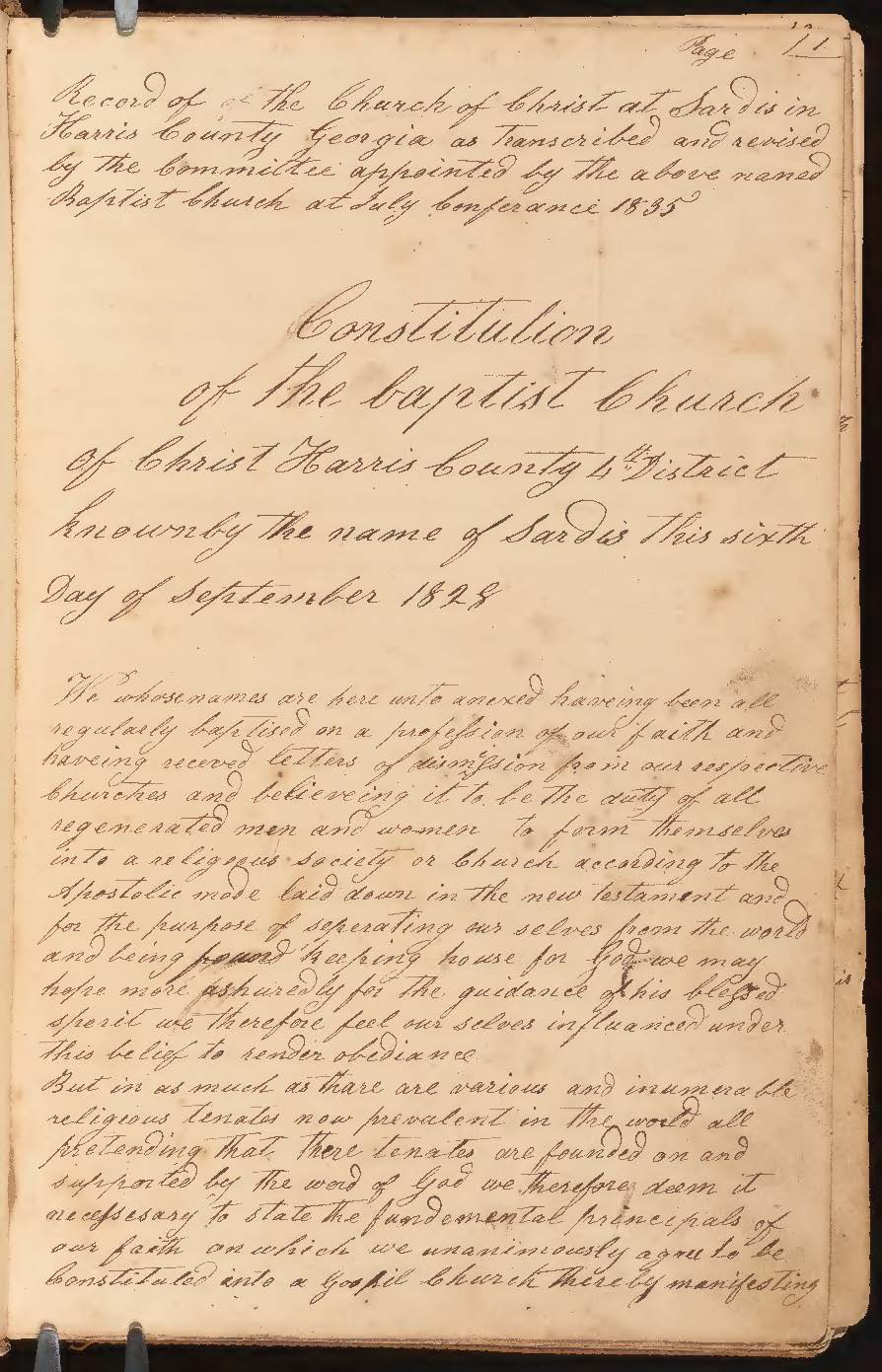
A record book covering the years between 1828-1915 of the Sardis Church of Christ is now available in the Digital Library of Georgia. The Sardis Church of Christ, associated with the Primitive Baptist Church, was one of the first churches to be established in Harris County, in west-central Georgia. This resource belongs to the Chipley Historical Center of Pine Mountain, Georgia, and has been made available online thanks in part to the DLG’s Competitive Digitization grant program, a funding opportunity intended to broaden DLG partner participation for statewide historic digitization projects.
The record book and descriptive information are available at:
Harris County was established in 1827, carved from Muscogee and Troup Counties, and from lands ceded by the Creek Nation in the 1825 Treaty of Indian Springs, and reaffirmed in the 1826 Treaty of Washington. A year later, in 1828, the Sardis Church of Christ was formed.
For the most part, the Sardis Baptist Church of Christ records follow a predictable format of when a meeting was held, who preached at the meeting, and that an invitation was given. The records also contain names of those that joined by declaration or by letter, and those that left by their own choice.
The Sardis Church also had African American members. Before the Civil War, these members are often listed only by their first names and are often denoted as “property of,” indicating their status as enslaved individuals. After the Civil War, the notations change to “colored” or sometimes “freedman” and their last name was often included. However, no matter what race, the Church always referred to a member as Brother or Sister.
At the beginning of the twentieth century, the church minutes in the record book become shorter and shorter for each meeting, and membership declines. This is probably due to the establishment of other churches nearby and the increased reliability of roads and transportation.
Although the Sardis church no longer exists, the church record book is a valuable tool for both those researching Primitive Baptists in regions other than the wiregrass region of Georgia or for those researching very early Georgia churches.
Malinda Brooks, a member of the board of directors of the Chipley Historical Center, notes:
“Personally, I have used the Sardis minutes in preparation of two published family genealogy books…Researchers are excited to find out when their family members entered and exited the Sardis membership, including the death dates of some members. These death dates, especially those that have not been found elsewhere, are treasures to researchers. Most recently, a woman researching her family for her Daughters of the American Revolution (DAR) membership application was able to find ancestors in the Sardis record book which helped strengthen her DAR research, especially given that the DAR was unable to track the correct ancestor.”
Featured image:
Title: Record book of the Sardis Church of Christ
(attachment: chipley_scc_sard_Page_005.jpg)
About the Chipley Historical Center of Pine Mountain

The Chipley Historical Center is located in Pine Mountain, Georgia next to City Hall in the original city hall building, built just after the turn of the twentieth century, and still contains the original jail cells. Learn more at the Chipley Historical Center’s web site at chipleyhistoriccenter.org.
About the Digital Library of Georgia

Based at the University of Georgia Libraries, the Digital Library of Georgia is a GALILEO initiative that collaborates with Georgia’s libraries, archives, museums and other institutions of education and culture to provide access to key information resources on Georgia history, culture, and life. This primary mission is accomplished through the ongoing development, maintenance, and preservation of digital collections and online digital library resources. DLG also serves as Georgia’s service hub for the Digital Public Library of America and as the home of the Georgia Newspaper Project, the state’s historic newspaper microfilming project. Visit the DLG at dlg.usg.edu.

Registration open for Conservation Enclosures for Libraries and Archives

UPDATE: Georgia Archives Spring Book and Paper Conservation/Preservation Workshop Series

Registration open for Conservation Enclosures for Libraries and Archives

Date: June 12 – 14, 2020
Fees: $350
Location: Georgia Archives, Morrow, GA (Greater Atlanta)
Registration deadline: June 5, 2020
Registration fees include all materials, and lunch and snacks will be provided.
Should the minimum number of attendees not be met by the registration deadline, the workshop will be postponed and the attendees refunded if they wish to cancel their registration.
Due to the COVID-19 pandemic, we are implementing additional health and safety measures to protect the workshop attendees and staff. These include:

  • ·       Reducing the maximum workshop capacity to 10 people to ensure a 6-foot distance between persons and individual work areas.
  • ·       Increasing cleaning and disinfection of all the workshop spaces and surfaces.
  • ·       Limiting sharing of work areas to an absolute minimum and cleaning the surfaces between use.
  • ·       Requesting attendees to bring and wear face masks for the duration of the workshop.
  • ·       Requiring all workshop staff and assistants to follow CDC hygiene and social distancing guidelines and to wear face masks.
  • ·       Requiring hand washing upon entry for all persons.
  • ·       Providing individual pre-packaged lunches and snacks.
  • ·       Including video projection for demonstrations.
  • ·       Prohibiting sharing of tools and materials.
  • ·       Prohibiting non-workshop persons access to the workshop areas.
For more information or if you have any concerns please contact Sigourney Smuts at sigourney.smuts@usg.edu
Registration is open for the other postponed workshops, which will be rescheduled for later in 2020 with additional health and safety measures. 

  • ·       Preservation Management for Cultural Heritage Institutions – $200 – date to be determined
  • ·       Introduction to Paper Conservation – $350 – date to be determined
  • ·       Book Conservation for Circulating and Reference Collections – $350 – date to be determined
A discounted price of $1050 is available for registering for all four workshops.
Location: Georgia Archives, Morrow, GA (Greater Atlanta)
For more information please contact Sigourney Smuts at sigourney.smuts@usg.edu

Call for GHRAC Awards Nominations

Reward Excellent Work in Archives
Call for GHRAC Awards Nominations
Morrow, GA, April 9, 2020 – Do you know someone who has done outstanding work using, preserving, or making historical records more accessible?  Think about the historical or genealogical society, library, museum, county or municipal government, researcher, local historian, educator or student.  The Georgia Historical Records Advisory Council (GHRAC) wants to encourage and reward their exceptional efforts. 
The Georgia Historical Records Advisory Council (GHRAC) established the Outstanding Archives Awards Program in 2003 to recognize outstanding efforts in archives and records work in Georgia. By publicly recognizing excellent achievements, the Board strives to inspire others. Hundreds of organizations and individuals play a significant role in the preservation of our state’s documentary heritage. 
  
GHRAC has twelve different award categories for individuals and organizations. Award recipients will be honored at the Georgia Archives by the GHRAC Board at a ceremony during Archives Month in October. Nominations may be submitted through June 1. Nominations must be postmarked on or before June 1, 2020.  
All of the following are eligible for an award. (You may nominate your own organization.)  
  • local governments, courts, school systems, state agencies, and institutions
  • historical records repositories, historical societies, libraries, and museums
  • educators, students, and researchers
  • legislators and government officials
  • individuals and organizations who support archives and records management
  • specialized subject societies in related fields such as oral history, genealogy, folklore, archaeology, business history, etc.

Information about the GHRAC Awards Program is located on the website of the Georgia Archives, www.georgiaarchives.org. On the homepage, type “GHRAC” in the search bar. You can then click on the link to the “GHRAC Awards Program.” Here you will find the links for the Nomination Form and instructions, the Award Categories and Selection Criteria for all 12 awards categories, and a list of all prior award recipients.
A nomination package consists of the one-page nomination form (please provide all requested contact information), a 500-word summary or project description, a copy of the work itself, and any supporting documentation necessary to appropriately portray the complete work (in the case of a project which includes an exhibit, a website, or an audiovisual, instructional, service, or performance component). Please note requirements in the appropriate selection criteria for nominations.
If submitted electronically, one copy of the nomination package should be emailed to: christopher.davidson@usg.edu. If submitted as hard copy, seven (7) complete nomination packages should be sent to: GHRAC, Georgia Archives 5800 Jonesboro Rd. Morrow, GA 30260 [Copies will not be returned.] Nominators should pay particular attention to the following requirements: 1. Georgia students who research and write in an area other than Georgia history or a Georgia subject must use the resources of Georgia records repositories to qualify for these awards. 2. A letter of support from a professor, teacher, adviser, or other appropriate representative of an organization or institution must accompany students who nominate themselves or are nominated by a family member. Award recipients are typically notified in August or September, and the annual GHRAC Awards Reception and Ceremony are held at the Georgia Archives in October.
Don’t miss out on this opportunity to get involved and shine the spotlight on the organizations and individuals all across Georgia who are dedicated to preserving and sharing our history, and improving our record keeping. 
For additional information, please contact GHRAC by phone at 678-364-3806, or email christopher.davidson@usg.edu.

2020 HomePLACE Summer Digitization Internship

Purpose and Scope

The Roddenbery Memorial Library in Cairo, GA seeks highly-motivated, responsible applicants for a Summer Digitization Internship fieldwork opportunity. This is a part-time, paid summer internship opportunity lasting from May-August 2020, $10 an hour for a total of 200 hours of work. Intern work shall be conducted onsite at either the Roddenbery Memorial Library in Cairo, GA or at the Georgia Public Library Service offices in Atlanta, GA as determined by the project needs and student’s location. Accommodations will gladly be made for candidates completing the internship for course credit.

Minimum Education, Training, and Experience

The successful candidate will have a demonstrated desire to work with archival materials, will possess excellent communication skills, be detail-oriented, able to work independently, have fine manual dexterity, strong written and verbal communication skills, and strong experience using Windows-based applications and the Google Suite.

Essential Duties and Responsibilities

This position requires dependability, tact, knowledge of library policies and procedures, and the ability to work as part of a team. The ability to start, finish, or pick up work projects at various points, without direct supervision, is vital. Assignments will vary according to the individual project needs, and the intern may assist with other tasks as assigned. All equipment and training will be provided by Georgia HomePLACE.
The 2020 HomePLACE Summer Intern will contribute toward making digitally available 54 audio oral history interviews with African American citizens from the Cairo, Georgia area. The project, which was conducted in 1982, will also include scanning and description of 50 color slides of African American churches in the area.
The Digitization Intern will:

  • Research biographical details about the interviewees, as well as relevant historical information about Cairo in order to best describe the collection;
  • Research any privacy restrictions;
  • Create a collection-level finding aid and box list;
  • Rehouse original media into archival enclosures where required;
  • Convert recordings from VHS to digital video;
  • Scan slides on a provided flatbed scanner;
  • Perform quality control checks to ensure successful conversion;
  • Record descriptive metadata and create a detailed record for each recording and image;
  • Upload recordings to the Roddenbery Memorial Library’s YouTube account;
  • Create subject access to the recordings using the Oral History Metadata Synchronizer;
  • Create a press release and other promotional material, including but not limited to blog and social media posts and a web graphic;
  • Assist staff of the Roddenbery Memorial Library in designing a public program related to the themes and content of the digitized collection;
  • Keep a daily log of work and prepare a final report of work completed;
  • Tour the DLG and GPLS offices and work with staff to ingest the records and recordings;
  • If applicable, complete work required for course credit.

The Digitization Intern may:

  • Reach out to the partner organizations for possible collaboration;
  • Hand key transcription for full-text searchability;
  • Assist staff of the Roddenbery Memorial Library in implementing a public program related to the themes and content of the digitized collection;
  • Co-curate an online exhibit and/or subject guide to related collections. Knowledge, Skills, and Abilities
  • Knowledge of general library and archival principles and philosophy;
  • Computing proficiency, including the use of Microsoft Office and Google Suite applications;
  • Knowledge of basic library operational principles, practices, and application of Roddenbery Memorial Library policies, procedures, and activities;
  • Effective communication and interpersonal skills;
  • Ability to work with people with tact, patience, and courtesy;
  • Ability to maintain regular, predictable, and punctual attendance;
  • Ability to learn metadata standards and schemas;
  • Ability to learn technical processes for making digital files publicly accessible;
  • Ability to read and interpret print, script, or cursive handwriting.

About the Partnership

The Summer Digitization Internship program is a partnership between the Roddenbery Memorial Library and Georgia HomePLACE, a unit of the Georgia Public Library Service.
The mission of the Roddenbery Memorial Library is to continue our commitment to public service, assisting all individuals and groups in Grady County to attain the highest level of educational, cultural, economic and social enrichment possible.
Georgia HomePLACE encourages public libraries and related institutions across the state to participate in The Digital Library of Georgia, an initiative of GALILEO. HomePLACE offers a highly collaborative model for digitizing primary source collections, and is supported with Federal LSTA funds administered by IMLS through the Georgia Public Library Service, a unit of the Board of Regents of the University System of Georgia.

Apply

Applications can either be filled out online or printed and mailed to:

Director
Roddenbery Memorial Library
320 N. Broad St.
Cairo, Ga 39828.

Applications will be accepted until April 30, 2020.
Questions may be sent to jboudet@rmlibrary.org

Three Webinars about OHMS (Oral History Metadata Synchroniser)

Doug Boyd from the University of Kentucky is hosting three workshops about OHMS (Oral History Metadata Synchroniser). Registration is $39 per workshop. Learn more and register below.


Webinar: Introduction to OHMS

Tuesday, April 14, 2020 from 1:00 PM to 3:30 PM (EDT) (Click on the link for more details and to register)
Webinar participants will get a comprehensive introduction to OHMS and its capabilities, then focus in on the process of getting started using OHMS, the creation of new records, synchronizing transcripts, and indexing interviews, as well as the installation and configuration of the OHMS Viewer. The webinar will discuss both practical strategies for integrating OHMS into archival workflows and the utilization of OHMS by oral history projects outside of the archive. Finally, the webinar will look at different implementations of OHMS and provide a space for workshop participants to discuss and to ask questions. 

Webinar: OHMS Next Steps

Thursday, April 16, 2020 from 1:00 PM to 3:30 PM (EDT) (Click on the link for more details and to register)
OHMS Next Steps is a webinar designed for those who want more in-depth practical training, as well as an opportunity to explore more advanced features and workflows. Registrants will participate in a full training session on indexing oral history interviews and synchronizing oral history transcripts. In addition to indexing and synchronization, topics will focus on the batch importing of metadata, the new auto-synchronization feature for importing transcripts with embedded time code, the bilingual capabilities of OHMS, the creation of thesauri for indexing, and the implementation of the new project management capabilities. The webinar will provide a space for workshop participants to discuss and to ask questions. 

Webinar: Integrating OHMS and Omeka

Friday, April 17, 2020 (1:00 pm – 3:30 pm EDT) (Click on the link for more details and to register)
This webinar (taught by Doug Boyd and Janneken Smucker) explores how to integrate the OHMS plugin suite with Omeka to create a powerful discovery and user experience for online oral history collections.  By displaying the OHMS Viewer within an Omeka item, users can conduct a text search of interviews, finding corresponding moments in an online audio or video file. By integrating the OHMS Viewer with Omeka Classic, users can search interview indexes and transcripts across entire collections. Following a brief overview of OHMS and a detailed exploration of Omeka, workshop participants will learn about installing, configuring, and deploying Omeka and the OHMS plugin suite. Instructors will present sample Omeka sites utilizing the OHMS plugins as well themes that are optimized for use with the OHMS Viewer. Additionally, workshop participants will explore workflow strategies and more advanced aspects of creating an Omeka site utilizing the OHMS Viewer.

Columbus and Macon city directories now freely available online in the Digital Library of Georgia

Georgia’s public libraries continue to make new content freely available online during the public safety closures of the COVID-19 pandemic. Newly digitized Columbus and Macon city directories offer engaging social studies content for students and educator research.
March 31, 2020
CONTACT
: Deborah Hakes, dhakes@georgialibraries.org
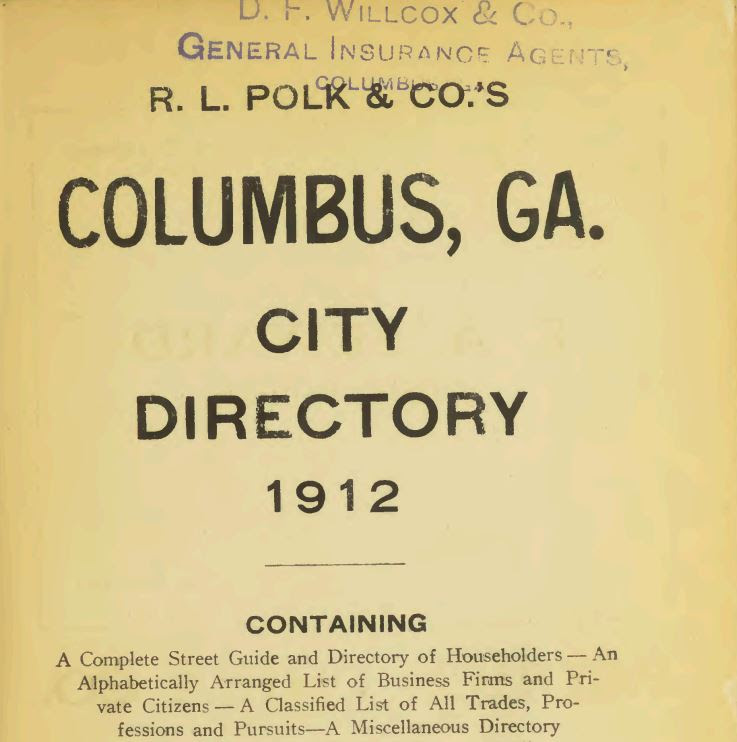
ATLANTA — Digitized city directories from Columbus (1859-1912) and Macon (1860-1899) are now available in the Digital Library of Georgia. Details in the collections about residence and resident make city directories ideally suited for local history and genealogy research, as well as student and educator research for social studies curricula.
columbus city directory from 1912
City directories antedate the phonebook as a listing of residents, businesses, organizations, and streets. In addition to basic location information, city directories frequently provided local governmental and civic information, street maps, church and cemetery information, and historical details about the city and surrounding areas. Information about individuals typically includes the resident’s name, title or salutation, home address, marital status and spouse’s name, race, occupation, and, if applicable, information about business ownership.
“We are thrilled to share city directories from the Middle Georgia Archives with our state and the world through the Digital Library of Georgia,” said Middle Georgia Regional Library Director Jennifer Lautzenheiser. “These directories allow researchers from all backgrounds to explore the rich and nuanced history of our communities.
Academics can learn about the trends that shaped our state. Students can lift the curtain on everyday life, and family genealogists can add details to the lives of their ancestors.”
The full-text searchable digital collections are part of a statewide initiative to digitize Georgia’s public domain city directories. The project is a partnership between Georgia HomePLACE, the digitization unit of the Georgia Public Library Service; the Digital Library of Georgia; the Columbus Public Library, part of the Chattahoochee Valley Libraries; and Washington Memorial Library, part of the Middle Georgia Regional Library System.
“Our city directories are frequently used by genealogists, local historians, and even owners of historical homes to learn more about the families and businesses that have been in our community’” said Wanda Edwards, Adult Services Coordinator for Chattahoochee Valley Libraries. “Digital access makes our directories available to customers regardless of their ability to visit the library.”
Students and researchers working from home will enjoy increased access to volumes that were previously only available onsite at their local library. Additional city directories available in the Digital Library of Georgia include Albany (1922-1949), Athens (1889-1958), and Atlanta (1867-1922).
“The importance of access to digital library collections has become more evident during these past weeks, said Edwards. “This is one more service we can provide for our users.”
####
Georgia HomePLACE encourages public libraries and related institutions across the state to participate in the Digital Library of Georgia. HomePLACE offers a highly collaborative model for digitizing primary source collections related to local history and genealogy. HomePLACE is a project of the Georgia Public Library Service, a unit of the Board of Regents of the University System of Georgia. HomePLACE is supported with federal Library Services and Technology Act funds administered by the Institute of Museum and Library Services through the Georgia Public Library Service.
Based at the University of Georgia Libraries, the Digital Library of Georgia is a GALILEO initiative that collaborates with Georgia’s libraries, archives, museums, and other institutions of education and culture to provide access to key information resources on Georgia history, culture, and life. This primary mission is accomplished through the ongoing development, maintenance and preservation of digital collections and online digital library resources. The Digital Library of Georgia also serves as Georgia’s service hub for the Digital Public Library of America and as the home of the Georgia Newspaper Project, the state’s historic newspaper microfilming project.
Middle Georgia Regional Library serves six counties across Central Georgia. The library’s mission is to connect all people to the information necessary to improve their lives through excellent services and materials.

The Chattahoochee Valley Libraries is a seven-branch system that serves more than 250,000 people in four counties: Muscogee, Chattahoochee, Marion and Stewart. The Library system is the most widely used cultural institution in the region, with more than 120,000 residents holding library cards. Our mission is to be your place, your partner, your library.

SGA Board of Directors Issues Statement Regarding COVID-19

COVID-19 Resources

Statement from the SGA Board of Directors

March 20, 2020

Atlanta, GA — The Board of Directors of the Society of Georgia Archivists (SGA Board) fully endorses the Society of American Archivists (SAA) Council’s March 18, 2020 statement regarding the COVID-19 pandemic.  

Given the danger of contact with this contagion, the SGA Board calls for those archival institutions in Georgia which have not already closed to the public to do so immediately and discontinue requiring non-emergency staff to report to work. As of March 20, 2020, the infection and death rates in Georgia continue to climb at an exponential rate. In an effort to flatten the curve and avoid overwhelming our medical resources, archivists’ focus should be on supporting people—our professionals, staff, and the general public—as they self-quarantine and/or shelter-in-place.

In its statement, the SAA Council recognized “that it can be challenging to develop remote work activities that support the material and unique preservation imperatives of archives. However, in this time of crisis, individual health and safety are of utmost importance.” The SGA Board agrees with this position, and furthermore endorses the inclusion of financial safety in this list of imperatives. While all effort should be put toward finding options for remote work (SAA’s Accessibility and Disability Section has created a working document or identifying projects), the SGA Board urges cultural heritage institutions, corporate, government, and private archives to continue to pay and provide benefits to their professional, staff, student, part-time, contract, temporary, and independent workers through the duration of this crisis.

SGA will be providing information and daily updates about operational changes to Georgia’s archival institutions via its website. Archivists are encouraged to report changes in their institutions’ operations using this form. Resources for archivists and librarians navigating the COVID-19 pandemic, in addition to those provided by the CDC, WHO, and Georgia Department of Public Health, can be found at the link.

The full statement can be viewed here.
The spreadsheet of Georgia archives affected by COVID-19 closings can be viewed here.