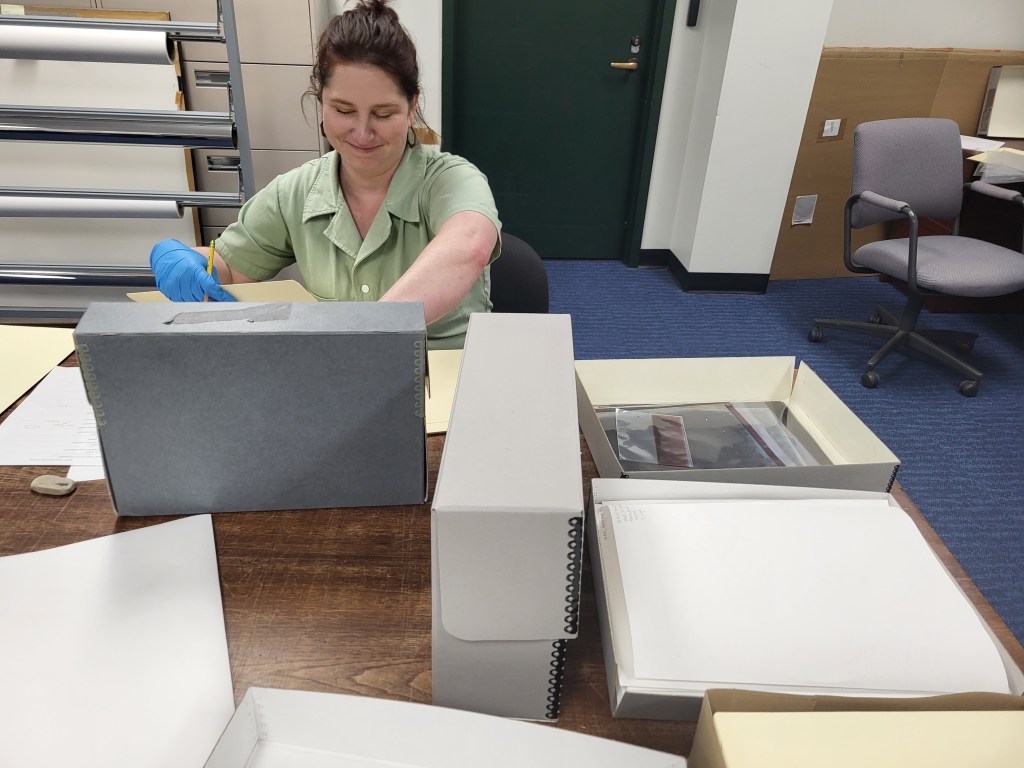
2024 Carroll Hart Scholarship Winner-Catherine Amos!

I had a truly rich and educational experience with the Georgia Archives Institute, and I cannot
stress enough how grateful I am to have been given the opportunity to attend the program as
the 2024 Carroll Hart Scholar.


Coming from a relatively small repository, I wasn’t sure what to expect from my experience at
the Georgia Archives. I applied to the Institute with quite a few assumptions:
I thought most of the participants would be like me, not holding an advanced degree. In fact,
many in my cohort were already MLIS holders, which, admittedly, intimidated me at first. I was
worried that I would struggle to keep up. I’m grateful to say that I found quite the opposite to be
true. Both the detail of instruction and the robust participation of the entire cohort revealed to me
that we all had something to learn from the program, which both relieved and excited me. I
could chime in on best practices that my repository used in North Carolina, while soaking up
every bit of information about the theory and practice of archival studies from my instructors and
fellow students.


In particular, the group exercises we worked together on gave me so much insight into the daily
considerations of trained archival professionals, and really brought the lessons to life for me. In
every scenario, hearing the opinions and views from my fellow cohort members gave me a wide
variety of perspectives and approaches to each situation. We were able to ask questions about
best practices for our own collections, which usually received the inevitable answer from
instructor Pam Hackbart-Dean: “Well, it depends.” It also gave me an appreciation for the
unique strengths and weaknesses of different repositories, and the value of specialization within
the field. I learned that I primarily work as a reference archivist, but I do occasionally work on
tasks that would be under the role of a processing archivist or a digital archivist. While I am very
lucky to have been trained in multiple types of roles in my repository, GAI’s coursework on the
detailed process of digital archiving brought me up to date with practices that we simply don’t
employ at my repository, and probably won’t be able to in the foreseeable future (but will be
important considerations for our collections management plan).


I also assumed that my repository was small and very understaffed for its size. This assumption
was met with the fact that several in my cohort were the lone archivists for their collections, and
performed every duty and role associated with maintaining a collection, from collections
management to digitization to budgeting. I was completely surprised to learn, for instance, that
the National Archives at Atlanta has less than 10 full-time employees. Comparatively, my
institution has 4.5 full-time staff members and around 800 linear feet of collection materials.
Most of the other attendees were already working at an archive or special collections, many of
which were under broader academic institutions. I was the only student from a repository within
a public library, which is perhaps why I felt so uniquely equipped with a wide variety of resources
and training from my work at Buncombe County Special Collections.


I loved seeing the wide variety of repositories in the institutions that we were able to tour—it was
really fascinating to see how each approached their unique collections, and it was interesting to
compare each institution’s operations. The sheer size of the NARA’s southeastern division was overwhelming—their facility was completely at capacity, despite warehouse-sized storage rooms
filled with stacks that I estimated to be at least 20 feet high. Two of three floors in Emory
University’s Stuart A. Rose Manuscript, Archives, and Rare Book Library are dedicated to their
special collections storage, while their galleries and research floor boasts gorgeous views of the
campus and downtown Atlanta. A tour of the Georgia Archives took us to their conservation lab,
which featured impressive, high-tech equipment, and two dedicated manuscript conservationists
on staff. And finally, the Kenan Research Center in McElreath Hall at the Atlanta History Center
housed over 10,000 linear feet of collections, both manuscript and visual, and featured large
freezers for the storage of their fragile film collections.


My internship assignment was at the Atlanta History Center, so I spent my time there working in
the Kenan Research Center. Three days was a tight turn around for an internship, but proved to
be just enough to process one small part of a collection from start to finish. Kate Daly, the Visual
Archivist at AHC assigned me to work on the DeGive family photographs, and I was given one
oversize box of unprocessed materials to work with. Kate walked me through the process, and
over three days, we checked in with each other to review each step and ensure I was
performing my work thoroughly and accurately. The biggest hurdle of the internship was learning
a new collections management system—AHC uses ArchivesSpace, whereas my repository
uses ArchvEra, so I had a bit of a learning curve with the software.


In the end, I was able to complete a finding aid from start to finish, and arrange, describe and
re-house a small collection, which was a new accomplishment for me! The experience was both
enlightening and rewarding, and while brief, the internship provided just enough time to apply a
fair amount of the coursework we handled in the classroom. Having the opportunity to apply my
newly acquired knowledge and develop new practical skills cemented the experience for me,
and I found the course as a whole to be thoughtfully designed and well executed. The Institute
gave me the opportunity to connect with so many wonderful archival professionals, who I hope
to keep in touch with as I continue in the field.


I would like to thank the Society of Georgia Archivists and the Scholarship Committee, the
Georgia Archives Institute, our hosts at the Georgia Archives and Atlanta History Center, our
instructor Pam Hackbart-Dean, guest speakers Katherine Fisher, Tamika Strong, and Sheila
McAlister, and my fellow cohort, who all made my experience at GAI such a positive one!

SAA fellow-Christina Zamon

CHICAGO—Christina Zamon, head of Special Collections and Archives at Georgia State University, will be inducted as a Fellow of the Society of American Archivists (SAA) on August 15 during an awards ceremony at the Annual Meeting of SAA in Chicago, IL. The distinction of Fellow is the highest honor bestowed on individuals by SAA and is awarded for outstanding contributions to the archives profession.

A multi-hyphenate archival practitioner who has held many roles—including solo archivist, department head, educator, fundraiser, author, and mentor—Zamon earned her MA and MLIS from the University of Maryland. To solidify her professional trajectory in archives, she became a Certified Archivist through the Academy of Certified Archivists in 2005. In 2013, she demonstrated her trailblazing mentality by becoming one of the first Digital Archives Specialists through SAA.

Alongside these qualifications, Zamon has spent more than twenty years as a professional archivist, over the course of which she has served in increasingly responsible and challenging positions.  She dove into all aspects of the profession as a solo archivist at the National Press Club (NPC) in Washington, DC. In this role, she largely established the archives as an institution adhering to best practices as defined by SAA and other professional organizations. Notably, she was instrumental in finding and acquiring a suitable space to house the NPC’s archival records. Following her successful tenure at NPC, Zamon took on the role of head of Archives and Special Collections at Emerson College in Boston. No longer a solo act, she supervised the work of two full-time staff members as well as student workers and interns. Her work on the American Comedy Archives was pivotal in the establishment of Emerson’s new Comedic Arts Major and Comedy Center. Since 2016, Zamon has led the Special Collections and Archives (SCA) team at Georgia State University. Most recently, Zamon successfully sought and acquired nearly $350,000 in funding from the National Endowment for the Humanities for a new 9,800 sq. ft. media preservation facility, significantly improving the library’s ability to preserve fragile formats. In the past five years, Zamon has helped to secure over $1 million in grant funds for the department, increasing accessibility and preservation of important cultural heritage records.

Zamon’s success is not just limited to these places. Many archivists were introduced to her and her care and concern for archivists and archival work through her seminal work, The Lone Arranger: Succeeding in a Small Repository, published in 2012 by SAA. Created to help archivists working in small, underfunded repositories succeed, the guidance and support articulated in the text transcends institution types and has been used to build and sustain archival programs across the country, thus making it one of the most impactful SAA publications. It’s been so well received that Zamon was asked for a completely revised and new edition that is now re-written, expanded, and retitled. Alone in the Stacks: Succeeding as a Solo Archivist was released in May 2024.

Since joining SAA in 2001, Zamon helped formalize the Lone Arrangers Section, now the Solo Archivists Section. Additionally, she has served as the College and University Archives Section’s vice-chair and chair and co-chair/chair of the Awards Committee. Through these positions, she worked to have the section be responsible for the “Campus Case Studies” peer review process. More recently, Zamon has served on the steering committee and is currently the co-chair/chair of the Archives Management Section. In the past, she founded the Boston Area Archives and Records Consortium, bringing together archivists to support and share resources. She is also an active member of the Academy of Certified Archivists and has served in a variety of capacities with the Society of Georgia Archivists (SGA). Zamon served as the president of SGA in 2023. During her term, she helped move their strategic plan forward and restructured the organization to improve efficiency.

Her high degree of initiative, resourcefulness, commitment, and service to the field and SAA is best described by one supporter who wrote, “Christina is an absolute powerhouse who gives her all for this amazing profession.” Another added: “It would be easy to list Christina’s many professional accomplishments, but it would not do justice to the outstanding and long-lasting impacts that Christina continues to make on the archives profession.”

Zamon is one of seven new Fellows named in 2024. There are currently 198 Fellows of the Society of American Archivists.

Find the press release here: https://www2.archivists.org/recipients/2024/fellow-christina-zamon

Provenance – Call for Submissions


Provenance
 
seeks article submissions for upcoming issues! 

First-time authors also are encouraged to submit articles for consideration.


Provenance‘s primary focus as a professional journal concerns the theory and practice of the archival profession. Each year the Society of Georgia Archivists awards the David B. Gracy, II Award, a $350 prize which recognizes a superior contribution to Provenance.


For more information on submission rules and requirements, please visit the Policies page.


When you are ready to submit your article, you may do so by visiting the Submit Article page.


If you have any questions, please contact the Editor at provenance@soga.org


Thank you and please consider sharing with others who may be interested.

Call for Guest Critics!

The Interior Design Department at SCAD University in Midtown Atlanta is seeking a few more professional guest critics working in library services from the Atlanta Metro area. Sophomore undergraduate design students have been working hard for the past 5 weeks to create 3D architectural models for a project titled “Beyond the Bookshelf: Atlanta’s Authors in Dimensional Dialogue”, a modern take on a Worlds Book Fair or Book Biennale. The critique is from 9am-11am on Wednesday March 13th, 2024 at the SCAD campus in Midtown. If you’re interested in possibly attending and want to learn more about the event, please email Courtney Ryan, Professor, at cryan@scad.edu for details.

Upcoming Robert W. Woodruff Library Events

Print and Paper: The Wonderful World of Book Arts

Emory Libraries will proudly host book artist Jerushia Graham for a public presentation about her work.

Tuesday, March 12, 2024

12:00 – 1:00pm

Robert W. Woodruff Library

Jones Room (located on the 3rd floor)

Following Jerushia’s presentation, she will offer a hands-on workshop. (Space is limited)

REGISTRATION NOW OPEN!!

https://bit.ly/Emory-JerushiaGraham

Stop Motion Animation With Paper Cutouts Workshop

Tuesday, March 12, 2024

2:00-4:00pm

Robert W. Woodruff Library

Emory Libraries Conservation Lab

(located on the 1st floor)

Please send any questions to Ephranette Brown at Emory Libraries (ephranette.brown@emory.edu).

Provenance seeks Review Contributors for upcoming issues.

Reviews consist of critical assessments of books, software, websites, and/or other tools pertaining to the archival profession. Provenance‘s primary focus as a professional journal concerns the theory and practice of the archival profession.

If you are interested in contributing as a Reviewer, please email the Provenance Reviews Editor at reviews_provenance@soga.org to express your interest.
The Reviews Editor will follow up with you about potential titles still available for review, as well as review format/length requirements. Your suggestions are also welcome!

Any questions may also be submitted to reviews_provenance@soga.org
Thank you and please share with others who may be interested.

Provenance seeks article submissions for upcoming issues!

First-time authors especially are encouraged to submit articles for consideration.

Provenance‘s primary focus as a professional journal concerns the theory and practice of the archival profession. Each year the Society of Georgia Archivists awards the David B. Gracy, II Award, a $350 prize which recognizes a superior contribution to Provenance.
For more information on submission rules and requirements, please visit the Policies page.
When you are ready to submit your article, you may do so by visiting the Submit Article page.
If you have any questions, please contact the Editor at provenance@soga.org
Thank you and please consider sharing with others who may be interested.