
I had a truly rich and educational experience with the Georgia Archives Institute, and I cannot
stress enough how grateful I am to have been given the opportunity to attend the program as
the 2024 Carroll Hart Scholar.
Coming from a relatively small repository, I wasn’t sure what to expect from my experience at
the Georgia Archives. I applied to the Institute with quite a few assumptions:
I thought most of the participants would be like me, not holding an advanced degree. In fact,
many in my cohort were already MLIS holders, which, admittedly, intimidated me at first. I was
worried that I would struggle to keep up. I’m grateful to say that I found quite the opposite to be
true. Both the detail of instruction and the robust participation of the entire cohort revealed to me
that we all had something to learn from the program, which both relieved and excited me. I
could chime in on best practices that my repository used in North Carolina, while soaking up
every bit of information about the theory and practice of archival studies from my instructors and
fellow students.
In particular, the group exercises we worked together on gave me so much insight into the daily
considerations of trained archival professionals, and really brought the lessons to life for me. In
every scenario, hearing the opinions and views from my fellow cohort members gave me a wide
variety of perspectives and approaches to each situation. We were able to ask questions about
best practices for our own collections, which usually received the inevitable answer from
instructor Pam Hackbart-Dean: “Well, it depends.” It also gave me an appreciation for the
unique strengths and weaknesses of different repositories, and the value of specialization within
the field. I learned that I primarily work as a reference archivist, but I do occasionally work on
tasks that would be under the role of a processing archivist or a digital archivist. While I am very
lucky to have been trained in multiple types of roles in my repository, GAI’s coursework on the
detailed process of digital archiving brought me up to date with practices that we simply don’t
employ at my repository, and probably won’t be able to in the foreseeable future (but will be
important considerations for our collections management plan).
I also assumed that my repository was small and very understaffed for its size. This assumption
was met with the fact that several in my cohort were the lone archivists for their collections, and
performed every duty and role associated with maintaining a collection, from collections
management to digitization to budgeting. I was completely surprised to learn, for instance, that
the National Archives at Atlanta has less than 10 full-time employees. Comparatively, my
institution has 4.5 full-time staff members and around 800 linear feet of collection materials.
Most of the other attendees were already working at an archive or special collections, many of
which were under broader academic institutions. I was the only student from a repository within
a public library, which is perhaps why I felt so uniquely equipped with a wide variety of resources
and training from my work at Buncombe County Special Collections.
I loved seeing the wide variety of repositories in the institutions that we were able to tour—it was
really fascinating to see how each approached their unique collections, and it was interesting to
compare each institution’s operations. The sheer size of the NARA’s southeastern division was overwhelming—their facility was completely at capacity, despite warehouse-sized storage rooms
filled with stacks that I estimated to be at least 20 feet high. Two of three floors in Emory
University’s Stuart A. Rose Manuscript, Archives, and Rare Book Library are dedicated to their
special collections storage, while their galleries and research floor boasts gorgeous views of the
campus and downtown Atlanta. A tour of the Georgia Archives took us to their conservation lab,
which featured impressive, high-tech equipment, and two dedicated manuscript conservationists
on staff. And finally, the Kenan Research Center in McElreath Hall at the Atlanta History Center
housed over 10,000 linear feet of collections, both manuscript and visual, and featured large
freezers for the storage of their fragile film collections.
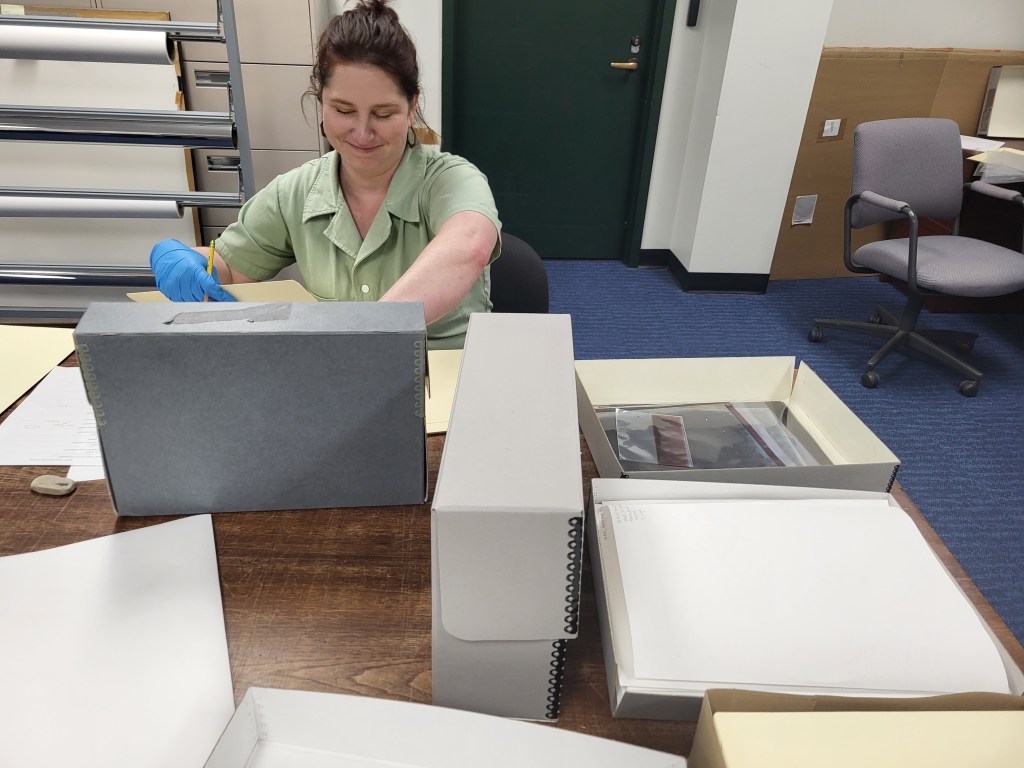
My internship assignment was at the Atlanta History Center, so I spent my time there working in
the Kenan Research Center. Three days was a tight turn around for an internship, but proved to
be just enough to process one small part of a collection from start to finish. Kate Daly, the Visual
Archivist at AHC assigned me to work on the DeGive family photographs, and I was given one
oversize box of unprocessed materials to work with. Kate walked me through the process, and
over three days, we checked in with each other to review each step and ensure I was
performing my work thoroughly and accurately. The biggest hurdle of the internship was learning
a new collections management system—AHC uses ArchivesSpace, whereas my repository
uses ArchvEra, so I had a bit of a learning curve with the software.
In the end, I was able to complete a finding aid from start to finish, and arrange, describe and
re-house a small collection, which was a new accomplishment for me! The experience was both
enlightening and rewarding, and while brief, the internship provided just enough time to apply a
fair amount of the coursework we handled in the classroom. Having the opportunity to apply my
newly acquired knowledge and develop new practical skills cemented the experience for me,
and I found the course as a whole to be thoughtfully designed and well executed. The Institute
gave me the opportunity to connect with so many wonderful archival professionals, who I hope
to keep in touch with as I continue in the field.
I would like to thank the Society of Georgia Archivists and the Scholarship Committee, the
Georgia Archives Institute, our hosts at the Georgia Archives and Atlanta History Center, our
instructor Pam Hackbart-Dean, guest speakers Katherine Fisher, Tamika Strong, and Sheila
McAlister, and my fellow cohort, who all made my experience at GAI such a positive one!
 sogablog.org